 Paths & Paws
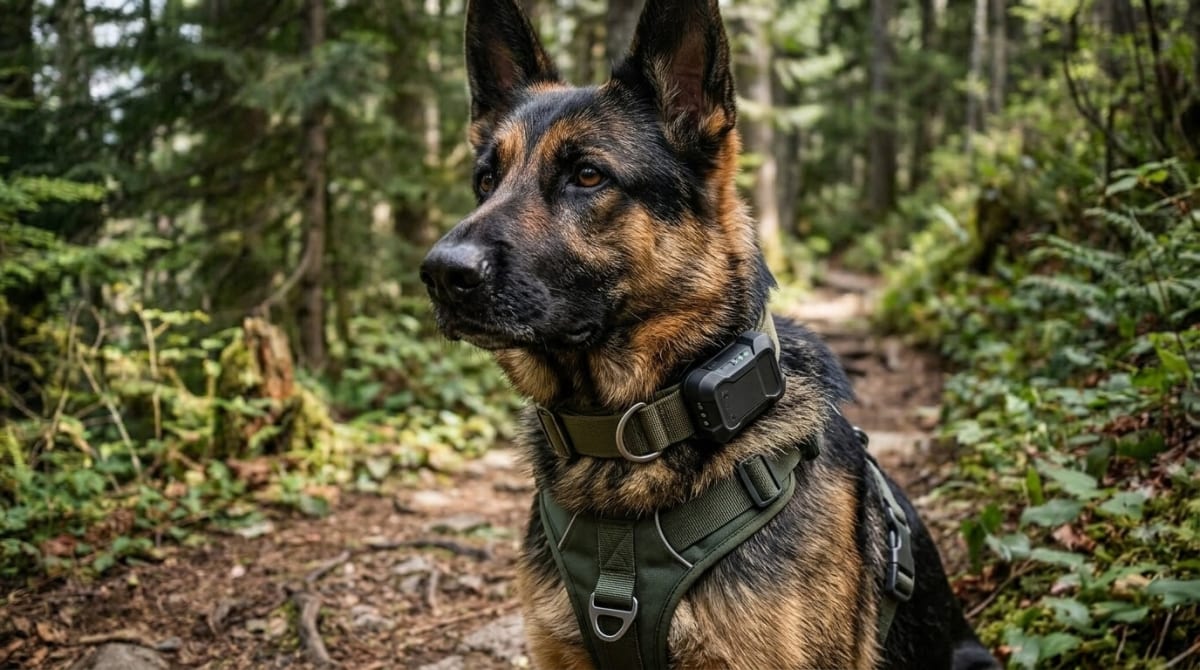
Most hikers assume a dog GPS tracker works anywhere the sky is visible. They're wrong. A tracker's ability to locate a dog means nothing if it cannot send that data back to a phone. This explains why the vast majority of consumer collars turn into dead weight the moment cellular service drops on a remote trail. Jasper is a 95-pound German Shepherd. When he decides to chase something, he vanishes fast. We've dragged both cellular and radio-frequency trackers across hundreds of trail miles, measuring battery drop, ping latency, hardware abuse, and signal blackouts in steep canyons to figure out when these devices save lives and when they just drain your wallet.
Key Takeaways
- 1Consumer GPS trackers go dark the moment cellular coverage drops - the name implies satellites do all the work, but they don't
- 2Radio-frequency trackers work without cell towers and cost $300-$800 upfront - the only reliable option 50+ miles from the highway
- 3Battery drain spikes in dead zones as the collar hunts for towers, cutting a two-week charge down to 48 hours on remote trips
- 4Most dogs get lost at the trailhead, not deep in the backcountry, where cellular trackers actually work fine
How dog GPS actually works
The confusion stems from the name itself. "GPS tracker" implies the satellites do all the heavy lifting. They don't. Every device relies on a two-step process, and the second step is where things fall apart in the backcountry.
Acquiring the location
The collar pulls signals from satellites orbiting the earth. It uses those pings to calculate precise coordinates by timing how long each signal takes to arrive. This part works almost anywhere outdoors. Even when a dense canopy of trees or heavy cloud cover hides the sky, modern dual-band chips can usually pinpoint the dog's coordinates within a few meters. The hardware sitting on the collar is surprisingly sharp.
Transmitting the location
Knowing the location doesn't solve the problem. The collar still has to get that data to a screen. This communication bridge is the weakest link in the entire chain. To cross that gap, the unit needs a network. Consumer devices like Tractive or Fi run on cellular networks. They hold a tiny internal SIM card and act just like a smartphone. If a phone can't load a webpage because you hiked out of range, the collar cannot send its location data to an app, though it will quietly save the path to its internal memory. Those movements remain completely invisible until the tracker hits cell coverage again.
Types of trackers for the trail
Hikers have to choose between three distinct tech setups. Getting this right depends entirely on the terrain.
Cellular trackers
These are the standard consumer models. They cost between $50 and $150 upfront, plus a required monthly data plan. They clip right on. For city parks and neighborhood walks, they work exceptionally well. They push rapid updates and reliable tracking as long as the cell towers stay within range of the hardware. If Jasper slips out the front door, a cellular tracker will guide me right to him. Take him up a remote logging road, and it becomes a useless plastic block.
Radio-frequency trackers
Brands like Garmin dominate this space. They originally built them for hunting dogs. They do not need cell service or monthly subscriptions. Instead, the handler wears a handheld receiver and the collar talks directly to it. They run between $300 and $800. They weigh more and force you to carry an extra device. But for backpacking fifty miles from the nearest highway, an RF tracker is the only piece of gear that will actually pinpoint a dog after they vanish over a ridgeline. We cover the best options in our best dog GPS trackers under $150 roundup for anyone ready to commit to a specific model.
Satellite trackers
This is a newly emerging category. Units like the Fi Ultra ping satellite networks when cellular coverage drops. They maintain the lightweight convenience of a cellular tracker while giving off-grid capabilities. Early field tests show promise. The tech is still raw though and comes with steep subscription costs. While bouncing a signal off a satellite in low earth orbit bypasses the dead zone issue, the hardware demands a clear view of the sky to function during an active search.
The real-world limitations
Even with the right tracker on the dog, you have to understand how they fail under trail conditions. We measured these variables on Jasper. The manufacturer marketing claims rarely match the backcountry reality.
Dead zone battery drain
Tech companies love to advertise extensive battery life. That metric assumes the dog is sleeping on the couch connected to home Wi-Fi. Take that same tracker into a spotty coverage area and it panics. It hunts for a tower. That desperate searching drains the lithium-ion battery exponentially faster than normal operation. A fully charged cellular tracker can die in forty-eight hours on a weekend backpacking trip just from struggling to grab a weak signal through the dense evergreen forest canopy. We watched this happen on a Glacier Peak Wilderness loop where Jasper's Tractive collar dropped from 100 percent to dead by mid-day two, purely from signal hunting.
Update latency and a dog's speed
When a tracker rests in battery-saving mode, it might only ping its location every three to five minutes. Jasper is a heavy dog. But he can still hit 15 miles per hour when he flushes a rabbit. In three minutes he can cover three-quarters of a mile. Relying on a delayed ping means walking toward an old location. The app shows a blue dot, but the woods are empty. Handlers have to trigger live tracking mode to get second-by-second updates. Hitting that button instantly accelerates the battery drain. Handlers are forced to choose between receiving precise location data during a crisis and keeping the unit powered long enough to finish a thorough physical grid search.
Water and impact damage
Most trail-rated trackers claim to be fully waterproof. In reality, the weak points are the charging ports and the plastic clips. We break gear often. Jasper plows through thick alder bushes and rolls in mud. After crossing rivers and scrambling over granite boulders, those plastic clips can snap. The trackers sit right on the dog's neck, absorbing every impact. If the collar housing cracks against a sharp rock during a scramble, moisture easily enters the battery compartment and wrecks the internal electronics long before anyone realizes the unit has gone offline.
When a tracker is actually worth the cost
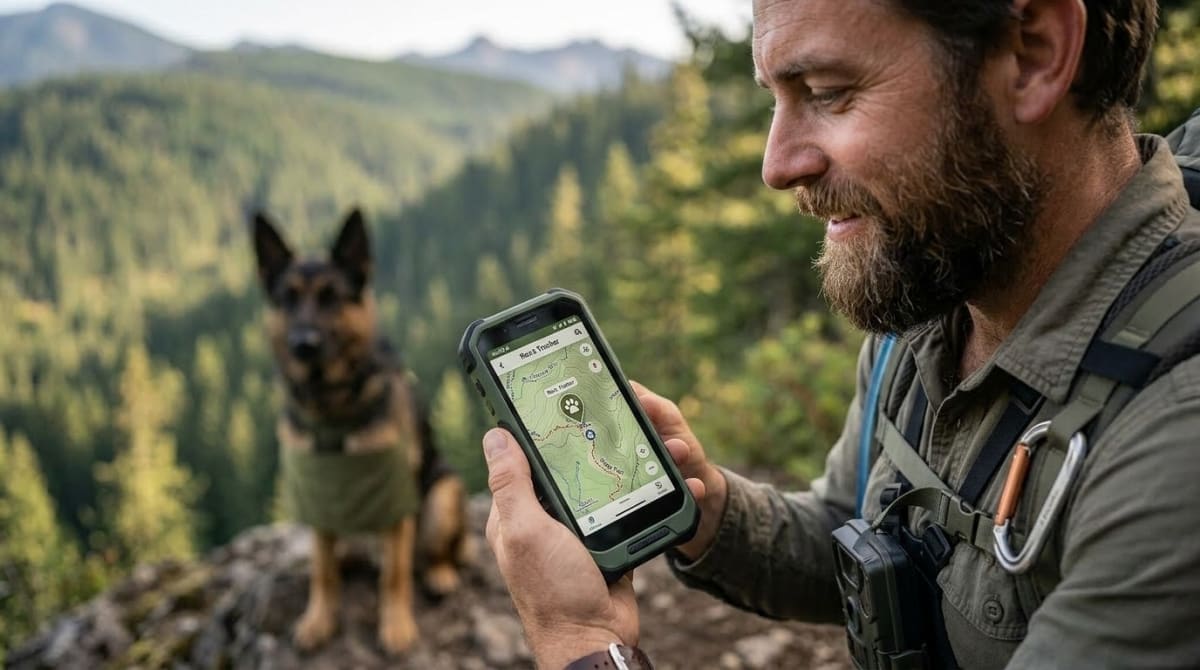
Statistically, finding a lost dog requires multiple layers of identification. A 2007 study in the Journal of the American Veterinary Medical Association showed that metal ID tags and implanted microchips remain essential for long-term recovery when a dog eventually hits an animal shelter system. But a GPS tracker has a totally different job. It enables rapid active recovery before the dog gets far. When debating the recurring subscription cost of a cellular tracker or the steep upfront price of a Garmin, here is when the investment actually makes sense.
Trailhead chaos
Most dogs don't get lost miles into the backcountry. They get lost in the parking lot. Handlers are wrestling with backpacks and lacing up boots. Another dog walks by. Or a squirrel darts across the pavement. The dog bolts before the leash is secured. Trailheads usually have decent cell service because they sit closer to main roads and civilization. A cellular tracker handles this parking lot scenario perfectly. It allows for interception before the dog crosses a dangerous highway or wanders into an adjacent neighborhood.
High prey drive breeds
Some dogs have an instinctual override switch. When Jasper catches the scent of an elk, his training competes with centuries of ingrained genetics. For hounds and northern breeds, prey drive can cause them to ignore recall commands entirely. Instinct takes over. They run blind. If a dog has a history of zoning out and chasing wildlife through the brush, a GPS tracker acts as a mandatory insurance policy against their own biology while recall practice continues. It buys a safety net. Combining a tracker with solid recall training is the most effective dual-layer approach - our dog chasing deer on hike guide covers the behavioral side of that equation.
Training the off-leash transition
When first giving a dog off-leash freedom on the trail, a tracker lowers human stress levels considerably. Dogs read body language. If the handler is tense and obsessively panicking about location, the dog gets anxious and erratic. Knowing the tech can locate them allows humans to project calm confidence. That confidence ironically makes the dog much more likely to stay close and check in organically without repeated verbal corrections.
When to skip it
If a dog hikes exclusively secured to a waist leash on familiar trails, a GPS tracker gives minimal return on investment. Save the money. A leash is a mechanical guarantee. Spend that cash on a secure harness and a climbing-rated carabiner that stops the separation from happening at all. Trackers strictly aid recovery. A leash guarantees prevention.
Frequently Asked Questions

Kelly brings an engineering mindset to dog hiking gear. After thousands of miles with Jasper testing every harness, pack, and boot on the market, he knows what holds up and what fails.
References & Further Reading
- Search and identification methods that owners use to find a lost dog. J Am Vet Med Assoc 2007 — J Am Vet Med Assoc (2007)