 Paths & Paws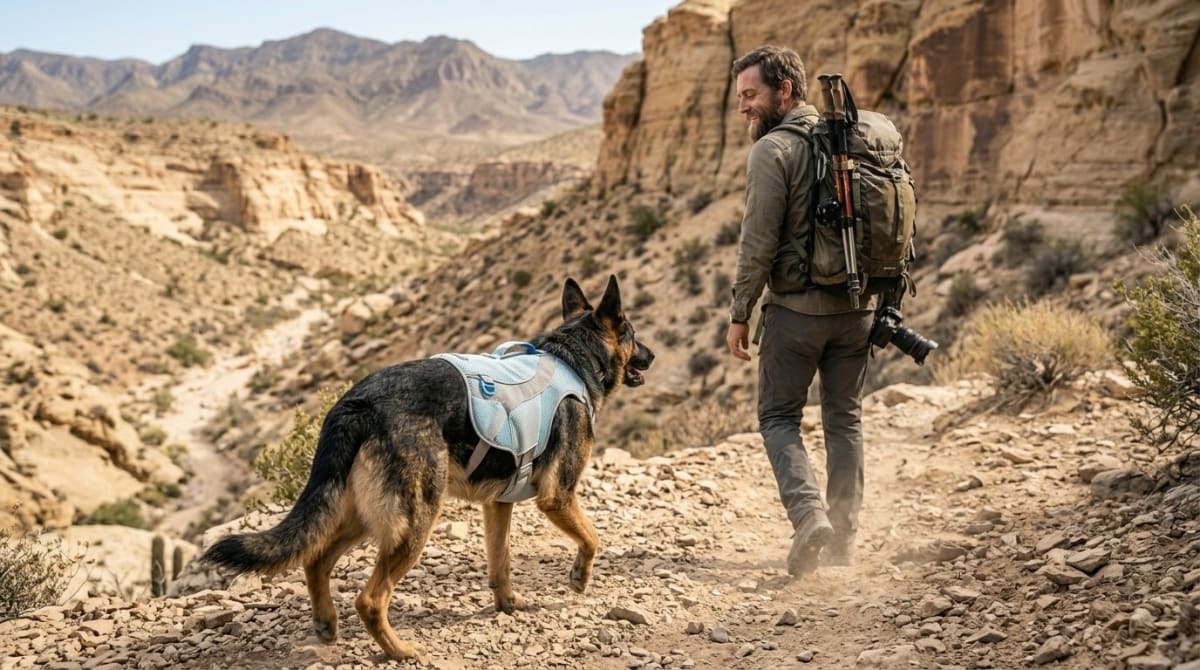
Do evaporative cooling vests actually work for hiking? Yes. We track Jasper's trail metrics closely. My 95-pound German Shepherd overheats fast on summer climbs. The first time we soaked a vest for him on Mount Si, his frantic panting dropped to a relaxed rhythm within ten minutes. His tongue retracted from a wide flat spade back to a normal resting shape.
These garments demand constant management. Forget to add water when the nylon bakes in the afternoon sun and you essentially force a dog to wear an insulating winter coat during the absolute hottest part of the day. You need to grasp the thermal mechanics before buckling one on. Use them in the wrong weather and you speed up heatstroke instead of stopping it. Let's look at how we run these.
Key Takeaways
- 1Evaporative vests use water and airflow to pull heat off your dog's body - a 2022 military dog study confirmed they keep core temperatures measurably lower
- 2They fail above 60-70% humidity - at that point the wet fabric becomes an insulating blanket that traps heat instead of releasing it
- 3Re-wet every 30-45 minutes on trail and carry a dedicated water supply; a dry vest in direct sun actively makes heat stress worse
- 4Train dogs to tolerate wet vests at home over several days before hitting the trailhead - a cold shock at the start creates lasting negative associations
The Biological Mechanisms of Canine Cooling
Dogs don't sweat like we do. They rely on panting and heat exchange through their paw pads. Panting moves air across the wet membranes of their mouth to evaporate moisture and chill their blood.
A soaked vest acts as a synthetic sweat system. Quality designs rely on a layered fabric sandwich where the outer shell bounces sunlight while the absorbent middle holds liquid and the inner mesh actively pulls thermal energy right off their skin. Warm wind hitting the garment vaporizes that stored water. That phase change drags heat away from the body.
A 2022 study in the journal Animals tracked military dogs working hard in high temps. Researchers ran dogs wearing evaporative setups against control groups wearing nothing at all. The data proved the wet garments kept core body temperatures measurably lower. Heart rates also bounced back much faster after the sprint.
That proves the concept holds up on the dirt. But those same researchers flagged a serious limitation. The gear needs liquid and moving air to run. If the breeze dies or the fabric bakes dry, the evaporative engine stalls out and leaves the animal trapped inside a thick nylon shell that actively blocks their natural ability to shed excess heat.
When Cooling Vests Become Heat Traps
Evaporation demands dry air. If the atmosphere is already saturated with moisture, water goes nowhere.
Out in the desert these setups are incredible. We run the dusty trails of Eastern Washington constantly and Jasper stays comfortable for miles in 15 percent humidity because the wind continuously strips the moisture off his back. The surface temp drops fast. Slide a hand under the harness and you physically feel cold air.
High humidity breaks this math completely. Pushing past 60 percent slows evaporation to a crawl. Above 70 percent the cooling engine dies entirely. The soaked vest just sits there. It turns into a suffocating thermal blanket. We never pack them for muggy days. If your own sweat isn't drying, the gear will fail. We go deeper on hiking with dogs in high humidity if you want to understand how ambient moisture affects every piece of trail gear, not just cooling vests.
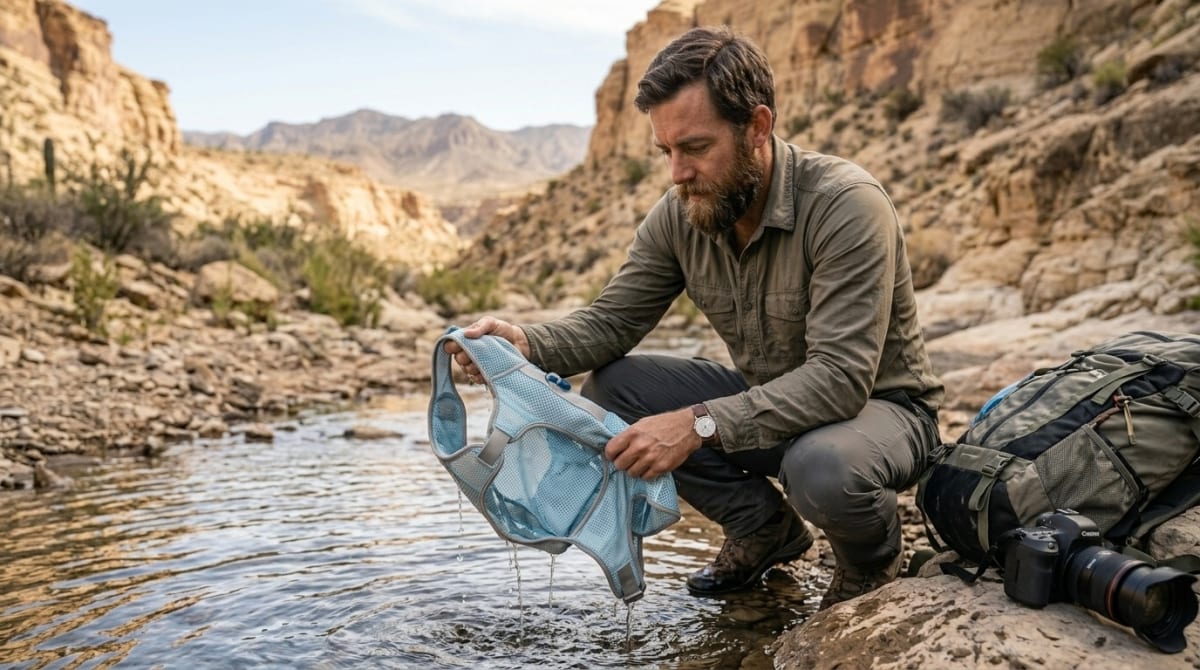
You also have to feed the system manually. An unsoaked shell is just an extra jacket. We dump half a liter of water over Jasper's back every forty minutes on exposed climbs. Check the fabric frequently. Squeeze the shoulder panels. If liquid doesn't bead up, soak it again right away. We haul a dedicated two-liter bladder in our own packs strictly to keep his gear saturated, and you absolutely cannot drink from that stash because it belongs to the thermal system.
If you can't carry enough extra weight to keep the nylon saturated from the trailhead all the way to the summit, leave it in the truck and stick to dawn patrols instead. You can't rely on random creeks. Summer creeks vanish in August. Pack the extra weight.
How to Train Your Dog to Wear a Cooling Vest
A cold, cumbersome jacket feels totally foreign to an animal. Jasper froze like a statue the first time we strapped a soaked rig over his spine. He refused to walk. He tucked his tail and threw me a highly stressed whale eye. You have to pattern this behavior before you hit the dirt.
Start dry inside the house. Let him sniff the gear. Don't shove it over his head right away. Drape the nylon loosely across his back while handing over high-value treats. Click the buckles and let him pace the living room for five minutes before stripping it off and paying him again. Do this for three days.
Take it outside once he tolerates the dry fit. Soak the fabric in lukewarm tap water instead of ice water for that first wet test. Freezing water shocks the system and builds an instant negative association. Wring the thing out well. Clip it on and instantly engage his brain in a fast-paced game. Launch a tennis ball or run through some rapid obedience drills to distract his mind from the weird clammy sensation hugging his ribs.
Try a quick neighborhood loop next. Keep the walking pace brisk. Watch his body language. If he shakes relentlessly or plants his feet, pull the gear and try again the next morning.
Once the dog completely ignores the wet fabric clinging to his chest, he's finally ready for actual miles on rough terrain. Skip this slow acclimation phase and just slap a cold rig on at the trailhead, and you will probably spend the first mile dragging a miserable confused animal up the mountain while he tries to scrape his new jacket off against every passing pine tree.
Affiliate Disclosure: Paths & Paws earns commissions from qualifying purchases made through links on this page. This supports our field testing and does not affect our recommendations. We only recommend gear that passes our trail testing standards. Learn more
Comparing the Three Types of Cooling Gear
Not all cooling tech runs on the same engine. You have to match the gear to the microclimate. The wrong choice wastes cash and puts the animal in danger.
Evaporative vests rule the hiking scene because they leverage simple water and airflow to dump heat. They weigh almost nothing empty and dominate in arid zones. We run the Ruffwear Swamp Cooler for the bulk of our summer miles. That wide chest panel blocks heat radiating straight up from the baked dirt. But they demand constant water top-offs to function.
Phase change rigs rely on frozen gel packs. You slot ice packs into internal mesh pockets right against the ribcage. These deliver intense immediate chilling regardless of what the local humidity is doing. We grab these for short explosive bursts of activity in thick weather. Take Jasper to a summer agility trial in heavy heat, and he wears a phase change setup between his runs. But those packs thaw in about an hour. Then you're just hauling dead weight. You can't recharge a melted ice pack in the backcountry.
Sun shirts offer a strictly passive alternative. They don't actively chill the body. They just use light-colored UPF fabric to bounce direct solar radiation. Jasper rocks a dark coat that soaks up sunlight like blacktop. A thin white sun shirt visibly drops his surface temp on exposed ridge sections.
We never stress about hauling extra water to feed a thirsty garment, making this low-tech passive approach brilliant for long desert stretches where every drop of water in the pack needs to go into a mouth.
Warning Signs the Vest is Failing
Gear doesn't make a dog bulletproof. Even running a wet rig, heatstroke remains a massive threat. You have to watch the dog, not the equipment.
The very first red flag is always the breathing. Normal panting rolls deep and steady with the tongue hanging loose. Heat stress panting turns shallow, panicked, and fast. The tongue physically widens at the base into a thick spade shape and the outer edges curl up. Jasper's tongue flares out dramatically the second he starts getting too hot.
Keep an eye on his feet. If he starts diving for every tiny patch of shade on the trail, kill the momentum and stop. Stumbling means you just entered a medical crisis.
The danger here is that a cold jacket masks the early warning signs. The outer skin might feel fine while the internal core temperature spikes into the danger zone, so you need to physically slide a hand under the nylon to check the chest. If the skin underneath feels hot, the system just failed. Strip it off fast. Drag him into the shade and offer cool water.
Dump water over his bare paw pads and the exposed skin on his inner thighs to kickstart an emergency thermal drop, and then start calculating the fastest possible route back to the truck before pushing straight to an emergency vet clinic. 106 degrees is where organ damage starts.
Frequently Asked Questions
Kelly brings an engineering mindset to dog hiking gear. After thousands of miles with Jasper testing every harness, pack, and boot on the market, he knows what holds up and what fails.