 Paths & Paws
People usually think a dog can haul a quarter of its body weight up a mountain. They can't. We tracked the actual kinematic shifts in dogs moving trail gear, and the hard data tells a different story. That 25 percent rule is dangerously outdated for a normal companion animal. Ten to fifteen percent of their total weight is the real target.
Take Jasper. He's a 95-pound German Shepherd. If we followed that old maximum limit he'd be lugging nearly 24 pounds of gear up the trail. That's absurd. We ran his gait with different pack weights on the steep dirt of Mount Si to see exactly how the added mass altered his baseline trotting mechanics and shifted his center of gravity across loose rock and roots. You see the physical strain long before hitting that upper threshold. Stride length drops. Peak vertical force on the front limbs spikes. Spinal compression kicks in.
Key Takeaways
- 1Ten to fifteen percent of body weight is the safe carrying limit, not the commonly cited 25 percent.
- 2A 2025 study found even 5-10% loads measurably altered gait mechanics in working dogs.
- 3Weight must sit over the front shoulders with a Y-neck strap design — rear-shifted loads lever the spine.
- 4Unbalanced saddlebags force gait compensation that exhausts core stabilizing muscles before the halfway point.
The Biomechanics of Canine Load Bearing
Dogs aren't pack mules. You have to look at their basic anatomy before strapping on extra gear. Horses have rigid spines backed up by massive load-bearing muscles. Dogs rely on highly flexible thoracolumbar regions built for agility and quick bursts of speed. Dumping excess weight on that flexible bridge creates instant structural stress, forcing the entire skeleton to compensate for the unnatural downward pressure.
A 2025 study in the Journal of Experimental Biology mapped exactly how working dogs move under weighted packs. Researchers stuck kinetic trackers to the animals to watch their real-time movements and found that hauling just five to ten percent of their body mass measurably altered their normal gait on the trail. Shortened stride lengths. Forward-shifted center of mass. Shepherd breeds actually took the most impact on their joint kinematics compared to spaniels. This data proves that even minor loads change how a dog navigates the route.
Ten percent is the safest baseline for most healthy dogs. It works perfectly for weekend camping trips and standard day hikes. For Jasper ten percent equals 9.5 pounds. That allowance easily covers his personal water, high-calorie trail snacks, emergency boots and a basic medical kit.
Fifteen percent is the absolute maximum functional limit. This upper boundary only applies if a dog hikes multiple times a week over varied terrain and they need to show excellent muscular health and strong orthopedic function to even attempt it.
That 25 percent myth comes from intense military standards. Those working animals undergo rigorous daily conditioning and specialized breeding programs. Pushing a companion pet to that punishing limit courts permanent joint damage and spinal compression.
How Strap Design Changes the Functional Weight
Scale weight only gives you half the picture. The dynamic load shifts dramatically based on how the harness actually distributes force across the skeleton.
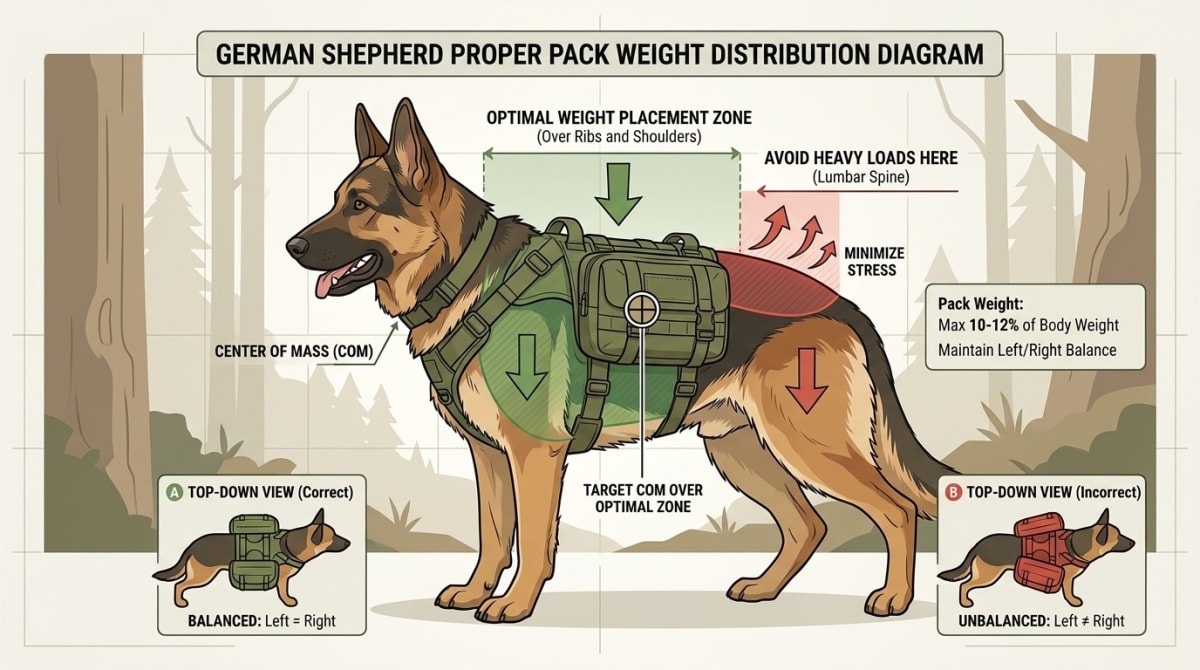
Weight has to sit directly over the front shoulders. That specific section of the frame provides the strongest structural support. Sliding weight further back toward the middle of the spine turns the load into a mechanical lever. It creates severe strain on the lower back and forces the rear legs to work harder.
A Y-neck strap design is basically mandatory here. The front straps need to form a clear Y shape right across the chest. This structural geometry allows the shoulder blades to move freely during a full trotting stride, whereas horizontal chest straps severely restrict the scapula and shorten the dog's natural forward reach. That restriction artificially speeds up fatigue.
We monitor load shifting constantly on steep elevation drops in the Cascades. When Jasper descends a sharp grade a poorly fitted rig inevitably slides forward toward his neck. This shifting mass amplifies the peak vertical force crashing down onto his front limbs with every single step. A tight pack prevents this slide while introducing new risks to breathing and circulation. The standard two-finger rule applies to all strap adjustments. Two fingers should slide easily between the nylon rig and the ribs.
Spinal clearance requires frequent trail checks too. A loaded backpack should never sag directly onto the spine itself. The weight must rest entirely on the ribcage and thick shoulder muscles.
Balancing the Load for Symmetrical Movement
Symmetry matters more than raw weight. An unbalanced rig destroys a natural stride immediately.
Even a tiny discrepancy in the saddlebags pulls the entire skeletal system out of strict alignment. A two-ounce difference between the left and right sides forces the dog to compensate mechanically by altering their footfall pattern. They lean sideways. This continuous micro-adjustment exhausts the stabilizing muscles in their core before you even reach the halfway point of the hike.
We weigh each side of Jasper's pack with a digital luggage scale before we leave the trailhead. Hands just cannot judge balance accurately. A water bladder on the left side might feel identical to a bag of kibble on the right but the digital scale always reveals a discrepancy. Get the numbers exactly equal.
Drinking water ruins that perfect balance during the hike. If a dog drinks from a hydration bladder on the right side the left side instantly becomes heavier, meaning the remaining water requires constant manual redistribution to keep the spine aligned. We fix this by splitting Jasper's water into four small flasks rather than two large bladders. When he drinks one flask from the right side we move a flask from the left side into our own human backpacks. The pack stays even.
A Field Protocol for Conditioning Your Dog
Just strapping ten percent of a dog's body weight onto them rarely results in a good hike. Their stabilizing muscles need time to adapt. We rely on a structured four-week protocol to safely build up Jasper's trail tolerance before attempting any serious elevation gain.
Week one involves zero added weight. During week one the dog simply wears the empty pack on standard neighborhood walks to completely desensitize them to the feel of the straps and the awkward bulk of the empty saddlebags. They learn how to walk without panicking about the fabric touching their sides.
During the second and third weeks we introduce a five percent load. Bulky items take priority over dense weight at this stage. Rolled towels or empty plastic containers work well. This teaches the dog how to navigate narrow brush and tight trail sections with their new wider profile. They learn to account for the saddlebags without straining their joints.
By week four functional water weight is safe to add. Start small. Monitor the dog closely over uneven terrain to check their panting rate and their willingness to clear large trail obstacles. If Jasper hesitates before hopping over a downed log the pack is too heavy. Drop the weight immediately. The goal is a fluid, confident jump.
Heat management plays a massive role during this entire conditioning phase. A backpack is basically an insulated coat. It traps heat against the core and restricts airflow right across the ribs. Total distance capacity drops by at least twenty percent when dogs wear a pack on warm days.
Recognizing Joint Strain on the Trail
Dogs rarely whine or stop moving when their joints hurt. They hide the discomfort and try to keep pace with the rest of the group. Spotting the early warning signs of overload requires paying close attention to their movement mechanics.
Acute strain shows up first in the gait. A dog carrying too much mass will often switch from a fluid trot to a stiff pacing motion. They might drop their rear end slightly lower than normal to compensate for the downward pressure on their hips. They might also refuse to sit during standard water breaks. Sitting down and standing back up with a loaded, unbalanced pack requires immense core exertion from the dog, so they often prefer to just remain upright rather than burning energy to rest.
Chronic strain appears the morning after a demanding hike. Look for stiffness when they rise from their bed. Watch for a shortened stride length during that quick morning walk around the block. If these signs appear the load exceeded their physical capacity the day before. Our guide on dog recovery after a long hike covers exactly what to watch for in those first 24 hours.
Spotting any of these signs on the dirt requires immediate action. Stop walking. Unpack the saddlebags. The extra gear belongs in a human bag for the remainder of the trek.
Packing Strategy and Density Rules
Understanding volume versus density solves most packing problems on the trail. Some items take up massive amounts of space while weighing absolutely nothing. Other items fit right in the palm of your hand and completely destroy a strict weight budget.
Low-density gear belongs in the dog's pack. We fill Jasper's saddlebags with his foam sleeping pad, extra waste bags, lightweight trail booties and our emergency medical supplies because these items provide the necessary physical bulk to stabilize the pack without dragging down his spine. A standard canine hiking first aid kit weighs less than one pound. A collapsible silicone bowl weighs just two ounces.
High-density stuff requires careful math. Water is the ultimate density trap for well-meaning dog owners. One liter of liquid weighs exactly 2.2 pounds. If a dog needs three liters of water for a summer hike that liquid alone weighs over 6.6 pounds. Adding dry kibble for a multi-day trip blows past the ten percent limit instantly.
Dense items belong in human packs. We keep the dense kibble and the vast majority of the shared water in our own backpacks. The dog carries the bulky, lightweight gear. This split keeps the load on the dog under ten percent.
Frequently Asked Questions
Filed under
Kelly brings an engineering mindset to dog hiking gear. After thousands of miles with Jasper testing every harness, pack, and boot on the market, he knows what holds up and what fails.
References & Further Reading
- The biomechanics of working dog locomotion II: Loaded trotting. J Exp Biol 2025 — J Exp Biol (2025)