 Paths & Paws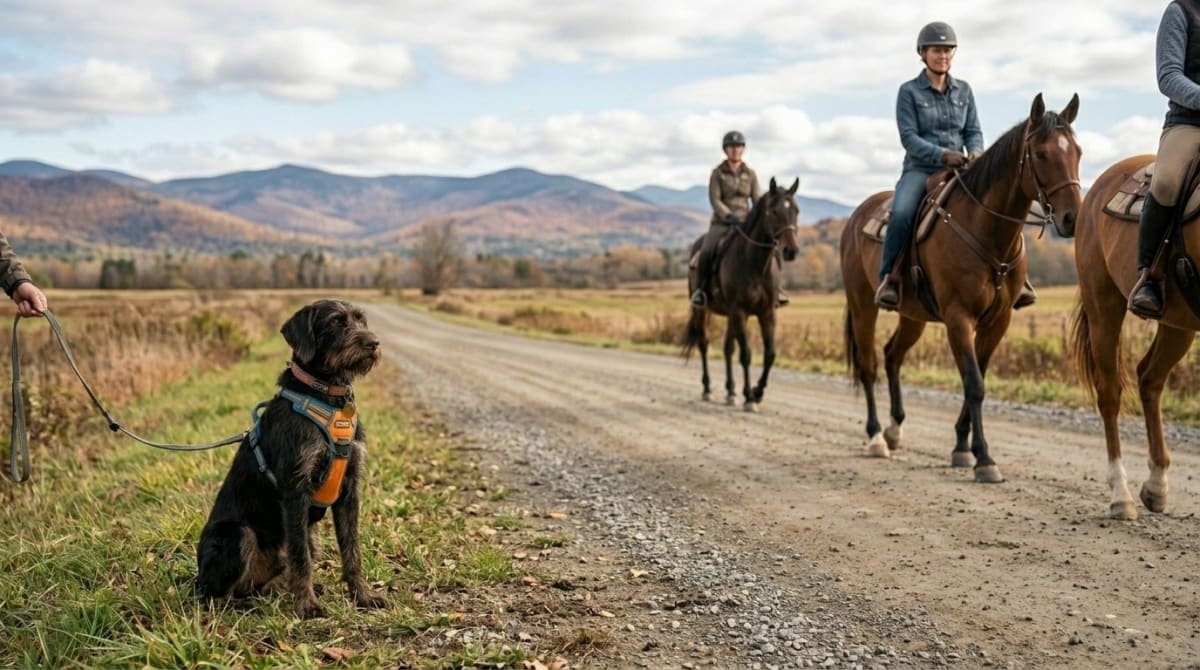
A 1,000-pound animal bolting down a dirt track is an immediate emergency. Most dog walkers freeze. Hesitation gets people hurt. You have to move first. When we first took Scout, my 50-pound Lab mix rescue, up to the Cascades, we totally botched our first horse encounter on a tight ridge, and the resulting chaos showed me exactly why trail guidelines exist in the first place. Scout barked once. The giant animal shifted its weight backward in a panic. The rider had to rein hard to stop a full spin on the loose gravel. We got incredibly lucky nobody fell down the embankment.
We find a lot of hikers assume riders will just handle their own animals. That assumption leads to ugly wrecks. We dug through incident reports on shared paths and talked to equestrian groups about collision patterns. Quiet dogs rarely cause problems. But staring or lunging triggers drastic behavioral shifts in horses. The fallout from these wrecks almost always lands on the hiker. You need a reliable sequence to keep everyone breathing.
Key Takeaways
- 1Move to the downhill side immediately. An elevated position makes your dog look like a predator about to pounce
- 2Speak to the approaching rider the moment they come into view so the horse hears human voices
- 3Hold your dog in a strict sit-stay and block its line of sight with your body and high-value treats
- 4Practice calm behavior near livestock before hitting the trail. You cannot teach obedience during a crisis
Why Horses Flee From Dogs
Horses survive by fleeing. A 2023 article in Today's Veterinary Nurse explains that horses enter flight mode just to put distance between themselves and a perceived threat, relying entirely on raw instinct rather than any rational assessment of the trail situation. Dogs look like predators to them. A staring canine mimics a hunting wolf.
Equines also process the world differently than we do. Since their eyes sit on the sides of their heads they have huge peripheral vision to spot rustling bushes, but this anatomy also creates blind spots directly in front of their noses and right behind their tails. A horse turning its head to check out a strange shape in the trees will react to a dog's stiff posture before the hiker even realizes something is wrong.
The warning signs show up before the actual explosion. You will see widened eyes showing white around the edges. The head shoots high. The ears pin flat against the skull. A terrified horse might bolt deep into the timber or it might just spin around blindly on a cramped ledge. Either reaction puts a rider at serious risk of bouncing off rocks.
Scout used to lock her eyes onto large livestock during our early hikes. We had to break that habit fast. Sustained eye contact tells a prey animal it has been targeted for a kill. When a handler forces their dog to break that visual lock, the approaching horse visibly drops its tension levels.
Trail Rules for Right of Way and Liability
Horses always get the right of way. Everyone else yields. Trail associations constantly review access policies for multi-use areas, and they will absolutely ban dogs from the system if accident rates spike because careless hikers refuse to secure their pets during passing scenarios. Hikers walking downhill usually yield to uphill traffic. That rule vanishes the second hooves are involved.
The rider's safety dictates how traffic flows out there. An unexpected spook can launch an equestrian with a high center of gravity straight down a deep ravine, and the resulting lawsuits almost always drop the legal and financial hammer squarely on the dog owner.
You have to step off the dirt early. A horse simply cannot squeeze around a stationary dog on a narrow track. The person in the saddle needs the widest path possible to push their animal past whatever it thinks is going to eat it. Land managers track these conflicts closely. When riders report out-of-control dogs, parks departments just change the signage at the trailhead to ban pets entirely.
Shared paths rely on predictability. A rider expects mountain bikers to call out and pull over. They expect hikers to step aside and say hello. When someone breaks this pattern by freezing dead in the middle of the path, the equestrian suddenly has to manage both a terrified horse and a human obstacle simultaneously, which completely overwhelms the safety margins of a backcountry route.
Step-by-Step Passing Protocol
Hooves approach. You have seconds. Let's walk through exactly how to clear the space.
Step 1. Move to the downhill side
An elevated position terrifies passing horses. A dog standing on a ridge above the path looks exactly like a cougar preparing to drop from the high ground, which triggers the panic response we are trying to avoid. Move downward. Secure stable footing well below the trail grade. Never climb up on a stump or a boulder to get out of the way because that towering silhouette will cause the animal to balk hard.
Finding a safe downhill spot on a steep switchback takes a little extra scrambling. Don't panic. Walk forward or backward until you locate a decent shoulder. The equestrian will wait.
Step 2. Speak to the approaching rider
Hiding silently in the brush looks exactly like an ambush. Say hello the second the rider comes into view. Hearing a human voice tells the horse that those weird shapes ahead are just people rather than lurking predators. Ask the person in the saddle how they want you to stand. Some equestrians will actually ask you to keep talking in an even tone as they walk by, since that continuous audio feed helps the animal track your location without turning its neck.
Step 3. Put the dog in a strict sit-stay
Grab the leash close to the collar. A loose tether lets your dog step forward at the worst possible second. Keep tension out of the line but hold it firmly. A rigid leash pumps handler anxiety straight into a dog's neck, and they interpret that sharp pressure as a signal to defend you. Stay relaxed while minimizing slack. If your dog doesn't yet have a reliable wait command on trail, that is the single skill worth building before you hike on equestrian-shared routes.
We practiced this hold at home before testing it in the woods. Grasp the loop with your right hand. Slide your left hand down the webbing until it sits about six inches above the collar clip. This two-handed grip gives you serious leverage if a lunge happens.
Step 4. Block the visual path
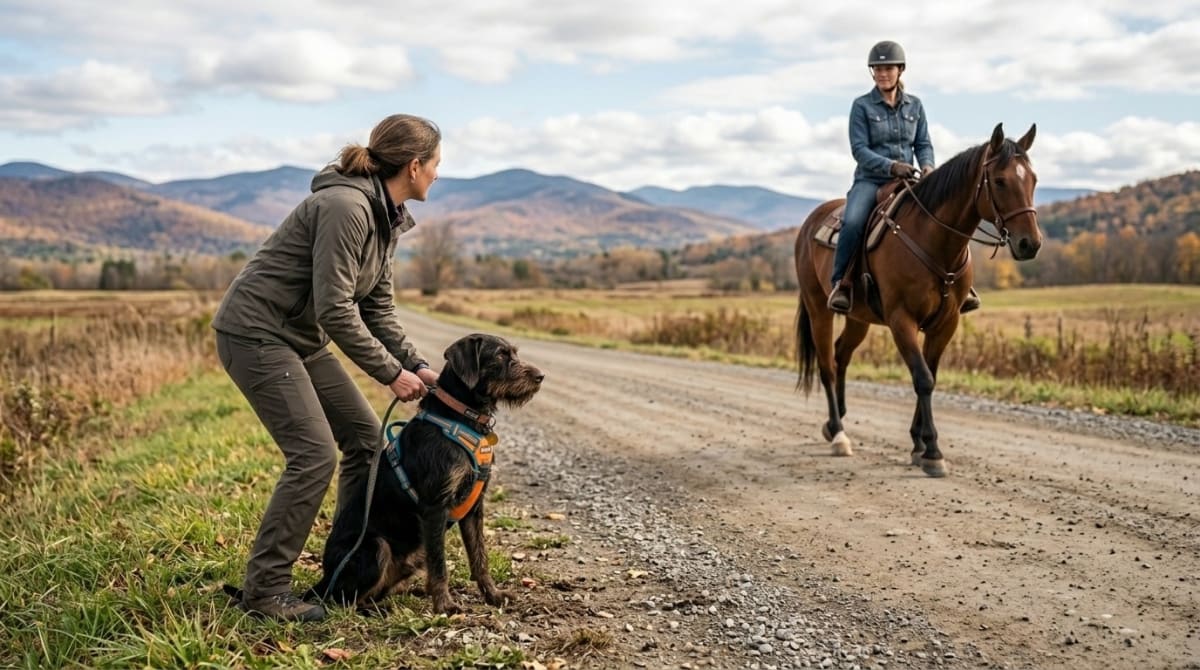
Step in front of the dog. Block its view. Feed high-value treats continuously to keep focus on the food rather than the beast walking past, since shattering that predatory stare is the most critical element of this entire procedure. We use a handful of cooked chicken for this part. Your body acts as a physical barrier so the dog cannot track the horse visually. The equestrian will deeply appreciate seeing someone actually control the situation. Keep the treats coming until the hoofbeats fade out.
Training Your Dog for Calmness
Trail manners require off-trail work. You can't teach obedience in the middle of a crisis. We spent six weeks running a structured desensitization protocol with Scout near a local farm fence line, and we handed over high-value treats the literal instant she broke eye contact with the livestock and looked back at my face for direction. That look-back is the foundation of counter-conditioning. The dog learns that ignoring the scary thing pays better than fixating on it.
Start in quiet spots. Reward every single glance. Teach a solid command in an empty living room first before taking it to a busy neighborhood park. Make the dog hold eye contact while bikes or runners blow past on the pavement, which builds the core focus required for intense outdoor distractions. You have to proof this stuff against fast movement before you ever introduce a horse. Dogs that struggle with any moving distraction often have a broader reactivity pattern worth addressing. Our guide on hiking with a reactive dog covers that groundwork in more depth.
Introduce the weird stuff gradually. A horse looks like a terrifying alien monster to a pup that has never left the suburbs. Drive out to rural roads with fenced pastures. We used to stand across the street from grazing cattle just feeding Scout chunks of cheese for staying quiet. Close the gap slowly over several days. Don't push past the threshold where the whining starts.
Rushing this ruins everything. An unprepared dog just reverts to panic barking when a massive horse appears around a blind corner. You lose all your progress. Take it slow so they build actual confidence around livestock.
Horses also carry a heavy scent that drifts pretty far down a canyon. A sharp shift in sniffing behavior usually means a rider is coming. Look for deep, frantic snuffling along the dirt edges. When Scout catches wind of a horse her ears pin forward and her tail goes stiff. Learn your dog's early warning signs. You can step off into the brush and set up a safety barrier before the equestrian even rounds the bend, which takes all the adrenaline out of the pass.
Four Common Passing Mistakes
Mistake 1. Hiding in the brush
Don't hide. Stay visible. We see so many hikers try to hide themselves and their pets behind giant trees or boulders when they hear hooves coming, but this just creates a terrifying jack-in-the-box effect when the animal finally spots those weird shapes lurking in the shadows. Stand out in plain sight where the horse can track you.
Mistake 2. Choking up on the leash
Handlers tend to yank the leash tight out of sheer panic before the horse even shows up. The dog feels that hard restriction on its neck. It assumes a threat is present. The dog starts scanning the trees for danger and immediately adopts a defensive posture. Keep your grip firm without putting constant tension on the line.
Mistake 3. Allowing whining or pacing
Don't allow anxious whining. Even a friendly little whimper sounds like a threat to a flight animal. Demand a silent sit. Redirect that nervous energy with basic obedience tasks until the distraction passes. A pacing dog creates visual noise. That constant movement forces the horse to keep checking over its shoulder.
Mistake 4. Moving back onto the trail too soon
Don't move until the rider is totally gone from view. A nervous horse can absolutely spook if it hears brush rustling right behind its hind legs. Wait for the hoofbeats to fade out. Step back onto the dirt quietly and resume the hike.
Frequently Asked Questions
Filed under
Sarah is learning to hike with dogs alongside her readers. Scout is her first trail companion, and she shares every mistake, success, and lesson learned along the way.
References & Further Reading
- Low-Stress Veterinary Visits for Horses. Today's Veterinary Nurse 2023 — Today's Veterinary Nurse (2023)