 Paths & Paws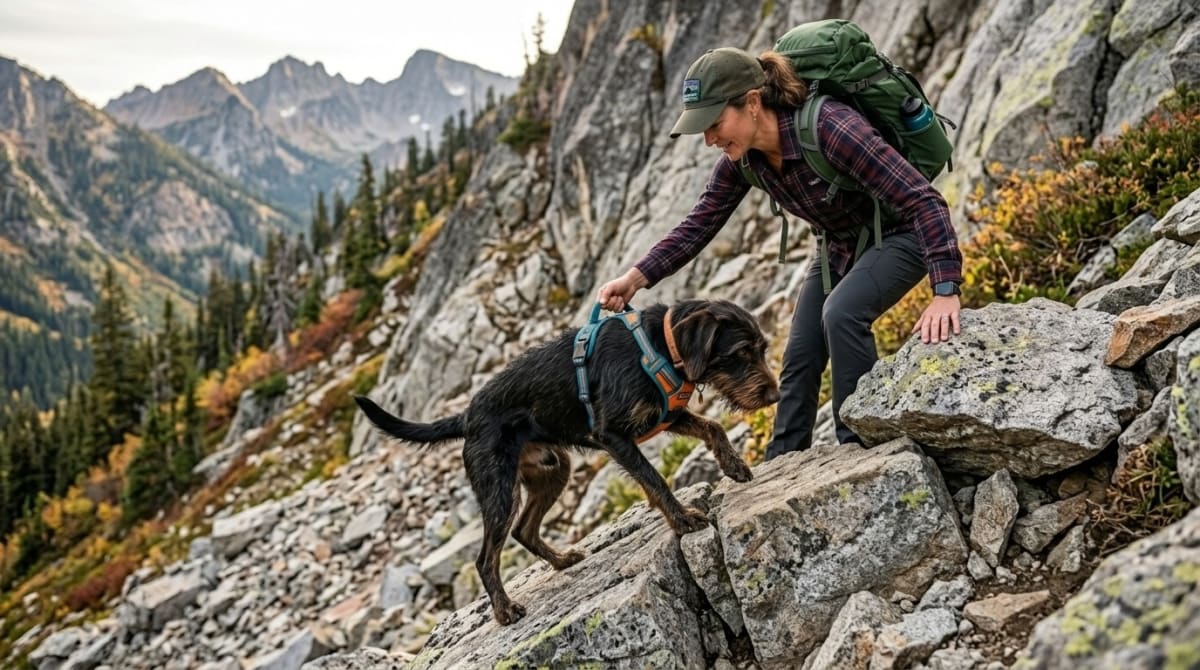
People misjudge rock. They look at a steep pitch and figure their dog will just bound up it. But a blown step on technical terrain does more than kill the weekend vibe. A drop from a steep slab often ends in catastrophic orthopedic blowouts that mandate five-figure vet bills and grinding months of rehab. We spent the summer tracking our 95-pound German Shepherd, Jasper, across jagged rock faces in the Cascades to figure out exactly how large breeds actually negotiate fixed ladders and steep scrambles. Joint strain spikes wildly on the way down. If you haul a 95-pound dog up a wall by a basic walking harness you risk tearing soft tissue in their shoulders the second those narrow straps bite into the joint cavity. We pushed through dozens of technical routes to test lifting techniques and multi-point harness designs, recording assist angles and stability metrics to see how we could get a dog through vertical puzzles.
Key Takeaways
- 1Proprioception training on flat ground is mandatory before any dog attempts a trail ladder. Skip it and you are asking for a scramble-induced injury.
- 2A four-point harness with a padded belly pan spreads lifting load across the chest and ribs. Standard Y-harnesses compress shoulder joints under vertical load.
- 3Descents are harder than climbs. Never let a large dog jump free from a scramble - manually lower them using the harness handle to eliminate landing impact.
- 4Know your turn-back threshold. If a section demands both hands for your own climb, it is too technical to safely manage a dog.
Foundation Training for Proprioception
Canines operate in front-wheel drive. They largely ignore what happens behind their ribs. Big dogs tend to blindly drag their oversized back paws over obstacles simply because they lack the localized rear-end awareness needed to intentionally plant a foot on a tiny, precarious target like a damp wooden ladder rung. We spent four tedious weeks running proprioception drills in our driveway long before Jasper even looked at a wooden trail ladder in the Cascades. You have to wire that neurological link between the brain and the back feet before asking an animal to handle sheer drops at elevation. Plenty of hikers skip this phase completely. Since we cannot talk a dog through ladder mechanics we had to drill the muscle memory into him on level ground. We burned entire afternoons on this. He figured out how to tap the squares. We moved at an absolute crawl. It started with a flimsy plastic agility ladder staked into the lawn. We paced him through the grid to force paw awareness and only tossed a reward when he planted a foot dead center without grazing the plastic rails. Once he locked down the flat grid we bumped up to cavaletti poles rigged just below his knees. That minor height change forced him to consciously lift and place those massive back paws instead of lazily dragging them forward out of habit.
Advancing to Fixed Trail Ladders
Looking through open air terrifies most animals. When a dog peers down through the empty gaps of a ladder rung their first impulse is usually to either freeze solid or panic and scramble. Both of those reactions get you hurt. Getting a dense dog up a trail ladder takes an absurd amount of patience. We broke Jasper in using a beat-up wooden step ladder propped against a garden retaining wall at a lazy twenty-degree angle. We manually guided him up a single rung at a time. We learned to issue a specific verbal cue for upward movement so he knew exactly when to focus on foot placement and when he should expect us to pull on the harness handle. We just say "step" for every single rung. If he freaked out and tried to scramble we killed all forward momentum instantly to prevent a slip. We just pinned the handle and waited. We held that static position until his heart rate dropped and his eyes finally locked onto the next wooden slat. Over time we bumped the angle up and started mixing in different surfaces. A slick cedar log bridge demands entirely different stabilizing muscles than a grated steel staircase bolted to a blank cliff face. We always spotted him from below.
Biomechanics and Harness Selection
Gear outright dictates what you can survive out here. A basic nylon walking rig might handle a dog pulling on level dirt but it fails completely the second you have to deadlift ninety pounds of thrashing canine over a granite lip. A dog carries about sixty percent of their static body weight on their front legs during a normal hike. When you tilt them into an upward scramble that entire load violently shifts backward onto the hips and spine. You need equipment built for that unnatural geometry. A 2023 study in the Journal of Applied Animal Welfare Science analyzed how harness design changes canine locomotion across 66 dogs using gait analysis. The researchers found that restrictive chest straps aggressively restrict normal shoulder extension. If you haul a ninety-pound dog up by a standard Y-harness you end up crushing the shoulder joints together while choking out their trachea. It wrecks their soft tissue over a long season. Jasper runs in a dedicated technical climbing rig with four structural contact points. The thing has a massive padded belly pan and two load-bearing handles stitched right over his center of mass. That belly strap is the whole ballgame. It stops the dog from slipping backward out of the rig. When we hoist his body weight up a tricky boulder problem the strain spreads across his ribs and sternum instead of ripping his armpits wide open. Single-strap designs cause serious pain.
Assist Techniques for Uphill Scrambles
Pushing upward means reading the rock first. Hauling a large animal up a steep pitch demands a rigid two-person system so Jasper never resorts to launching blindly at a wall. Our lead hiker scrambles up the obstacle first to establish a locked-in stance on level rock, while the rear hiker anchors directly behind the dog to physically block a sudden backward tumble. That rear spotter grips the back handle. They dial in steady upward tension without trying to actually curl the dog's whole body weight. We essentially act as a fleshy top-rope while the animal engages their own hindquarters to motor upward. Once he crests the worst of the crux the lead hiker grabs the front harness handle to steer his paws onto a safe landing zone. We hold that tension until his back claws find purchase. If we run a trail solo we always climb first and pull from above. Trying to shove a panicked dog from behind usually just ends with boots to the teeth or a giant animal sliding backward into the spotter's chest. We focus entirely on vertical lift.
Assist Techniques for Descents
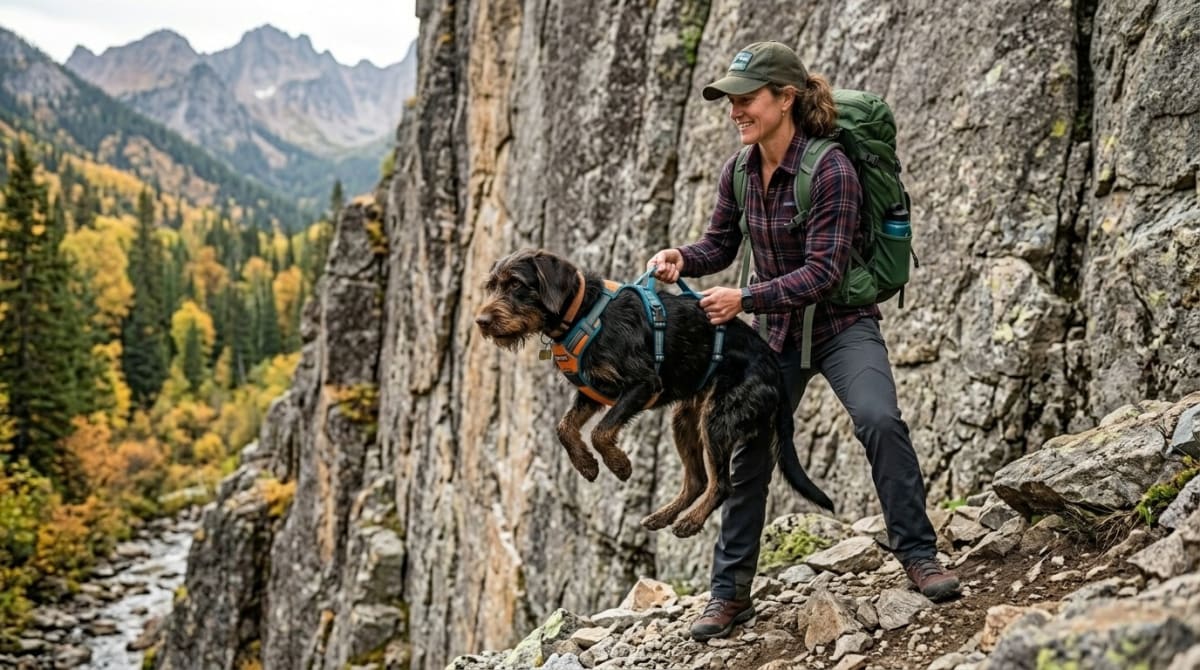
Gravity is absolutely brutal coming down. A ninety-five pound animal free-falling four feet off a granite shelf generates an alarming amount of kinetic energy upon impact. All that shock travels right up through the carpal bones and explodes into the shoulder capsules. We refuse to let Jasper jump down off a scramble unaided because those repetitive shockwaves accelerate early-onset arthritis and massively elevate the chances of blowing a tendon miles from the truck. You have to become a manual brake pad. We watch his elbows as he lands. If he splays his front legs outward when hitting the dirt he severely stretches the delicate tissues tying the shoulder blades to the ribs and that causes immediate dead-leg lameness. One of us climbs down first. We wedge into a stance just below the drop. We grab the rear handle to eat about a third of his body weight and physically lower his front feet down to the rock while verbally commanding a hold. He gets to step down like it's a staircase and the impact drops to zero. If the slab looks wet or holds loose scree we switch to a tandem lower where someone manages leash friction from the top while the second person safely catches the landing.
When Terrain Is Too Technical
The mountains do not care about the itinerary. There is a very real line out there where a steep hike turns into a legitimate mountaineering problem. We learned to respect that boundary early on. Our crew bails without a second thought if we hit exposed iron rebar drilled into a cliff wall or ladders dropping thirty feet into a ravine or slick granite friction-slabs with absolutely zero paw holds. Hauling a dog into that kind of exposure is reckless. If a section forces us to grip rock with both hands and pull our own body weight upward it is fundamentally too sketchy to manage while trying to spot a giant animal. We scour topo maps and dig through recent trip reports to flag these nightmare choke points before we ever pack the truck. It definitely beats hiking six miles in just to stare at an impassable cliff. Sometimes trail crews cut a dog bypass through the brush. But you cannot bank on that in deep wilderness. If we walk up to a scramble that clearly outpaces his current training we just drop our packs and eat a sandwich before heading back to the car. Knowing your limits keeps everyone out of the dog first aid kit.
Affiliate Disclosure: Paths & Paws earns commissions from qualifying purchases made through links on this page. This supports our field testing and does not affect our recommendations. We only recommend gear that passes our trail testing standards. Learn more
Obstacle and Gear Assessment
A decent trail ladder rests at a lazy slope and uses thick wooden steps rather than thin metal pipes that bite into paw pads. We hard-pass on any obstacle that hangs totally vertical or dumps out onto a nasty slope with no safe landing zone. We always look at the penalty for a fall.
Pulling a heavy dog requires a multi-point harness with a thick belly pan and at least one bombproof handle stitched into the spine piece so the dog's mass spreads across their chest instead of ripping their shoulders backward. Walking collars are a surefire way to snap a trachea if you try to lift with them.
Smaller breeds definitely run with a lower center of gravity. They squeeze through cave-like gaps with ease. But their stubby legs physically cannot clear a waist-high boulder problem. You end up tucking them under an arm like a football to get up the big stuff.
Sharp granite chews through soft paw pads fast. We smear a thick layer of protective wax on Jasper's feet before the rocks get nasty and inspect his toes after every major crux. When the rock turns truly jagged we lace up fitted boots for the extra friction. Our full breakdown of dog boots versus paw wax covers which option holds up on different rock types.
Frequently Asked Questions
Kelly brings an engineering mindset to dog hiking gear. After thousands of miles with Jasper testing every harness, pack, and boot on the market, he knows what holds up and what fails.
References & Further Reading
- Effect of harness design on the biomechanics of domestic dogs (Canis lupus familiaris). J Appl Anim Welf Sci 2023 — Journal of Applied Animal Welfare Science (2023)