 Paths & Paws
Most people think herding dogs just need more exercise to stop nipping on trails. They figure running their Cattle Dog or Australian Shepherd for five miles will exhaust the dog so much it ignores how the group moves. They get back to the trailhead. They wonder why the dog is still circling. Fatigue does not turn off genetics. A tired herding dog is just a cranky herding dog with less impulse control.
Scout is our 50-pound Lab mix. When we first started hiking with her, we discovered she definitely has some herding breed mixed into her rescue DNA. If our hiking party spread out on a narrow dirt path, she would drop to the back, nip my calves, and push me forward. She was just trying to keep her flock together. We had to figure out how to handle it.
You cannot train a herding instinct out of a dog. You have to redirect it. We looked into the biology of predatory sequences and learned how to manage Scout's behavior. We tested these methods on steep switchbacks and crowded flat trails alike. We will show you exactly how to handle trail nipping and circling without ruining the hike.
Key Takeaways
- 1Fatigue does not fix trail nipping - a herding dog's genetics demand the behavior regardless of how tired the dog is
- 2The nip is a modified predatory motor sequence bred to stop at the grab-bite, not a random act of aggression
- 3Giving the dog a job (a toy to carry, a loaded backpack) redirects the drive instead of fighting it
- 4Harsh corrections suppress the warning signs but leave the underlying anxiety intact, often making the bite worse
The biology of the trail nip
To fix the nipping, you must understand why it happens. Dogs do not herd because they are angry. They herd because their biology demands it. It is an instinctual loop that feels highly rewarding when completed.
Wild canids hunt using an eight-step predatory motor sequence. The full sequence goes like this. Orient toward the prey. Lock eyes. Stalk. Chase. Grab, bite, dissect, and finally consume the meal to create a complete biological cycle of hunting behavior that keeps the wild pack alive in harsh winter conditions.
Domestic dogs have modified versions of this sequence. A 2020 study in Frontiers in Veterinary Science outlines how selective breeding alters these steps. Retrievers are bred to orient, track, chase, and grab with a soft mouth. Terriers are bred to complete the sequence up to the kill-bite.
Herding breeds like Border Collies and Cattle Dogs are selectively bred to exaggerate the front half of the sequence. They orient, eye, stalk, and chase with intense focus. They are bred to stop at the grab-bite. That grab-bite is the heel nip. They are executing a genetic command programmed over hundreds of generations. A trail runner jogs past. The dog sees a flash of movement and the brain triggers the sequence. The nip is the biological conclusion.
Narrow singletrack trails amplify this drive. The tight space forces a linear hiking order. If one person falls behind, the dog feels the flock is splitting. They circle and nip to bring the stray sheep back to the group. Open fire roads usually cause less anxiety because the dog can see everyone at once and the space opens up.
Suppressing versus redirecting instincts
You will never erase a herding dog's instinct to manage movement. If you try to punish the nipping with harsh corrections, you often create anxiety and frustration. The energy does not disappear. It spills out into leash reactivity or excessive barking. You cannot fight genetics.
Instead of stopping the drive, give the dog a job. Cattle dogs and shepherds crave tasks. If you do not assign them one on the hike, they will invent one. Usually their chosen profession involves managing human ankles. You have to give them an alternative outlet that satisfies the predatory motor sequence without hurting anyone in the hiking party or causing chaos when passing strangers on a busy public trail.
We learned to redirect Scout's drive into acceptable outlets. A toy in her mouth mechanically blocks the grab-bite instinct while fulfilling the need to carry something. Toss on a dog backpack and suddenly she has a real job that demands focus. These changes interrupt the sequence before it starts. A toy occupies the mouth, and a pack redirects their kinetic energy.
Step-by-step trail management
High-drive dogs require proactive handling. You cannot wait for the dog to start nipping. Stay ahead of the triggers.
What you need
- Two tug toys
- A tough harness
- A standard six-foot leash
- A pouch full of soft treats
Leave the retractable leash at home. Retractable lines give a herding dog the distance to build up sprinting speed for a chase, making the eventual stop dangerous for both of you and destroying any tension control you had.
Step 1. Establish pre-trail engagement
Don't just open the car door and start marching. Spend five minutes in the parking lot doing focus exercises. Ask for eye contact and reward it heavily. Run through basic obedience commands. This sets the expectation that you direct the hike and they are on the clock.
Step 2. Manage trail geometry
Keep the hiking group tight. If there are four people, stay within twenty feet of each other. When we hiked Mount Si with a group, someone dropped back fifty yards to snap photos, which caused Scout to panic immediately as her genetic instincts told her the flock was separating. She tried to bolt backward. Keep the flock together. Put the dog in the middle of the pack so they can see the leader and the followers simultaneously.
Step 3. The toy carry technique
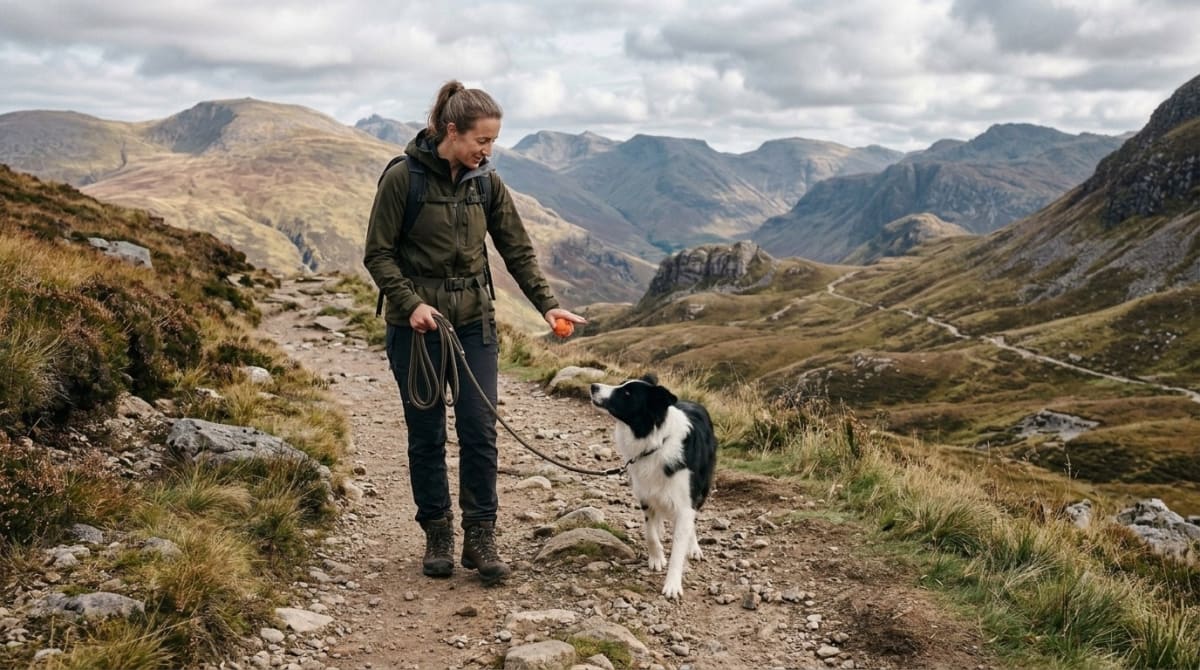
Give the dog a dedicated trail toy. When Scout gets overstimulated out on the dirt, we hand her a small rope toy to hold. A dog cannot nip heels if their mouth is full. The toy satisfies the biological need to grab and hold. If they drop the toy to nip, stop walking. The hike only continues when they hold the object.
Step 4. Redirecting the stare
When you see the dog lock eyes on a trigger, interrupt them immediately. The moment they switch from orienting to hard staring, the sequence has started. Use a sharp verbal cue. Turn and walk the opposite direction for ten steps. Reward them when they follow you and break their stare. Break the fixation before they move into the stalk and chase phases, because once a herding dog moves forward toward a target, verbal commands rarely override the instinct.
Common triggers and how to handle them
Trail environments are full of movement that mimics fleeing prey. You need a clear plan for the most common hazards. Fast movement triggers the chase instinct right away.
Trail runners and joggers
The dog locks on and lunges before you can react. Step off the path when runners approach. Put the dog in a sit-stay position facing the woods. Feed them soft treats continuously until the footsteps fade. Block their visual access entirely.
Mountain bikes
Bikes move fast and make weird gear noises. The spinning wheels mimic prey movement perfectly for a high-drive dog. Keep a firm grip on the leash. Create as much distance between you and the bike as the trail allows. A herding dog might try to bite the tires. We always put Scout behind us when bikes pass to create a physical barrier between her teeth and the spinning metal spokes that could severely injure both the dog and the cyclist.
Scrambling sections and rock steps
When humans climb over steep rocks, body movements become erratic. The change in speed and posture confuses the dog. Scout used to panic when we hit scramble sections in the Cascades. She would circle me and whine while trying to nip my boots. Command them to wait while you pull yourself up. Call them up only after you find stable footing. This prevents them from trying to herd you while you are off balance.
Off-leash dogs
An uncontrolled dog running up to the group will send a herding breed into overdrive. They view the strange dog as an interloper threatening the flock. Step in front of the dog. Use a firm voice to halt the approaching dog. Do not let the herding dog try to control the situation. Step forward and block their line of sight. If your own dog struggles with these encounters generally, our guide to hiking with a reactive dog covers the broader management approach.
Equipment that helps manage the drive
The right gear makes managing a herding breed much easier. A flat collar paired with a flexi-leash guarantees failure. You need tools designed to give you the upper hand.
Front-clip vests
A front-clip vest gives you control over a pulling dog. When a Border Collie lunges at a passing bike, the front connection point redirects that explosive momentum right back toward you. It interrupts their forward lunge without putting pressure on the trachea. We use a Y-style front-clip vest on Scout to make sure her shoulders have full range of motion on steep climbs. This keeps her comfortable but leaves us with the steering power.
Dog backpacks
Backpacks are excellent tools for working breeds. A pack gives the dog a real job. It grounds them mentally. The slight weight slows them down and gives them a sense of purpose. Start empty. Add weight gradually over three weeks until hitting ten percent of their body weight. We noticed a massive drop in Scout's trail anxiety the day we introduced her pack, as she stopped worrying about grouping the flock and started focusing entirely on hauling her own water supply.
Dedicated trail toys
Not all toys work for redirection. You need something long enough to keep hands away from a stimulated dog's mouth. A braided fleece tug toy works perfectly. It is soft enough to carry for miles and strong enough for a quick game of tug. Keep this toy hidden. Only bring it out on the trail so it retains its appeal.
Double-handled leashes
A standard leash is fine for open spaces. A double-handled leash is essential for narrow singletrack. These leashes have a second loop positioned right above the dog's back. When a runner drops in, you grab the short handle to lock the dog in a tight heel. It provides instant control without having to wrap the slack around your wrist multiple times. You just grab the second loop and pull them in.
The biggest mistakes handlers make
We see hikers making the same errors with herding breeds over and over again. Avoid these traps to keep the hikes stress-free. Bad handling makes the drive worse.
Assuming they will grow out of it
Herding drives intensify as the dog matures. A six-month-old puppy might just gently bump a leg. A two-year-old Cattle Dog will leave deep bruises if you ignore the behavior. Train the redirection early. The longer they practice the nipping sequence, the harder it becomes to break the habit.
Using harsh corrections
Alpha-rolling or hitting a herding dog for nipping destroys trust. These breeds are sensitive to handler pressure. Harsh punishment just adds more stress to an overstimulated brain. The dog will learn to hide their warning signs and go straight for the bite next time. Punishment suppresses the warning. The underlying anxiety remains intact.
Off-leash freedom too soon
Never let a herding dog off leash on a public trail until you have bulletproof verbal control over their chase instinct. You must be able to stop them mid-sprint. If you cannot call them off a running deer or a mountain bike, they belong on a six-foot leash. An uncontrolled herding dog is a massive danger to everyone on the mountain.
Forgetting mental enrichment
A hiking trail is physically demanding. It is not always mentally demanding. Herding dogs need puzzles to solve. Throw in some obedience drills during water breaks. Ask them to jump onto designated logs or wait at trail junctions. Make them use their brain. A mentally engaged dog is far less likely to resort to heel nipping because they are already processing the complex tasks you gave them instead of inventing their own jobs. A five-minute obedience drill burns way more mental energy than two miles of mindless walking.
Frequently Asked Questions
Filed under
Sarah is learning to hike with dogs alongside her readers. Scout is her first trail companion, and she shares every mistake, success, and lesson learned along the way.
References & Further Reading
- Selecting Dogs for Explosives Detection: Behavioral Characteristics — Frontiers in Veterinary Science (2020)