 Paths & Paws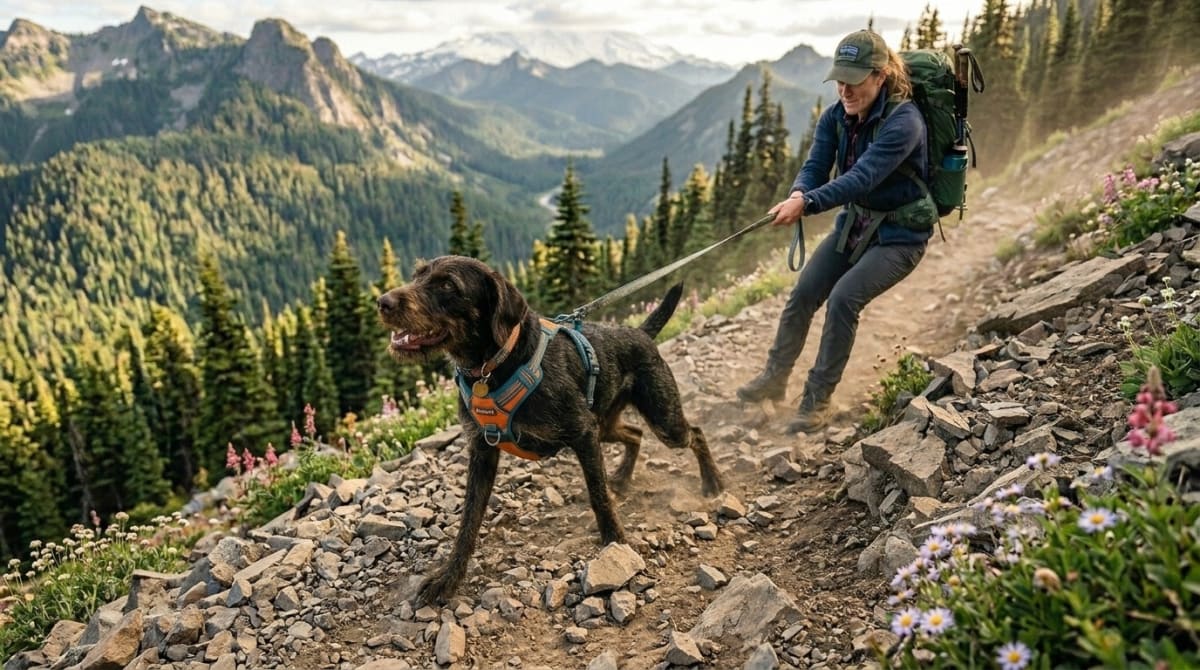
Scout hit the end of her leash on a muddy switchback and nearly dragged us both sideways down the hill. She weighs fifty pounds. The momentum felt like twice that. Over half of dog-walking emergency visits happen when handlers fall after being dragged, and steep terrain is where that statistic gets built. Gravity makes a sixty-pound animal feel like a freight train. When a dog pulls downhill, that added load strips away the reaction time you need to plant boots firmly on rocky terrain and remain standing. We dug into clinical data tracking leash tension mechanics and reviewed studies measuring the exact forces exerted by different equipment types during a descent to find the safest route down the mountain. The fix is physical and mental. We found the safest setup requires a front-attachment harness paired with speed-checking commands.
Key Takeaways
- 1Downhill terrain amplifies pulling force - research shows dogs can exert 125+ Newtons on descent, enough to destabilize a hiker
- 2Back-clip harnesses actively encourage pulling; front-clip harnesses redirect forward drive by pivoting the dog back toward you
- 3The stop-and-pause method - never moving forward while the leash is tight - breaks the pulling habit in three to four weeks
- 4Wrapping the leash around your wrist on steep terrain is dangerous; a hard lunge at the wrong moment can dislocate your shoulder
Why Downhill Pulling Breaks Balance
Flat terrain lets you brace. A downhill slope strips away that friction advantage entirely. A 2026 study published in the Annals of Biomedical Engineering tracked gait kinematics and leash tension to see what actually happens to the body. The researchers found that dogs routinely exert pulling forces exceeding 125 Newtons. That force hits completely differently on a decline. The human center of gravity naturally shifts forward. The leg muscles are already working overtime just to control the downward momentum of your own body weight. When the leash snaps tight, the animal pulls the upper torso down the fall line while the feet struggle to move fast enough to catch up and prevent a tumble. You lose your footing. The fall happens fast.
Excitement only explains a fraction of the problem. Dogs have a lower center of gravity and four points of contact with the dirt. They feel perfectly secure leaning into a severe drop. Humans rely on a delicate two-legged balance system. An unexpected 125-Newton jerk disrupts our dynamic balance completely. A 2023 epidemiological study in Medicine and Science in Sports and Exercise analyzed emergency room data. The researchers found over 422,000 leash-dependent walking injuries across two decades, and the result of a hard yank on a descending grade is often a fractured finger or a torn shoulder muscle from a nasty landing on jagged rocks.
Required Gear for Steeps
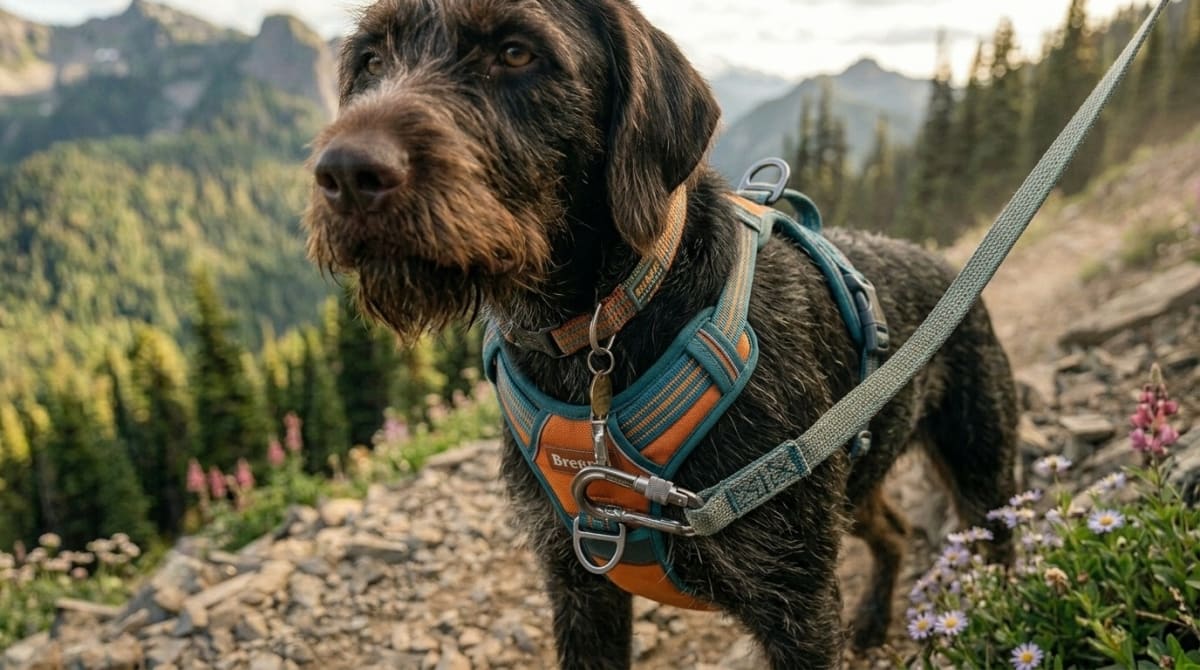
Back-clip harnesses actually encourage pulling. Sled dogs wear back attachments for a very specific reason. The setup allows the animal to throw its entire chest weight into the descent without losing its footing. Neck collars pose a totally different hazard. A driven dog will literally choke itself dragging a hiker down a trail before backing off the throttle. A 2024 study in PeerJ compared four types of leash-walking equipment and found that dogs pull less when using specialized front-clip gear, which physically alters the mechanics of their forward drive.
The safest rig requires two specific pieces of gear. First is a front-clip harness. The leash attaches right at the chest. When the dog lunges ahead, the tension forces the animal to pivot back toward the handler. This mechanical disadvantage kills the downward drive instantly. Second is a fixed-length leash. Retractable leashes provide zero tension control and belong nowhere near a mountain. A standard six-foot nylon or leather leash lets us lock our arm and brace for impact. A solid line of communication stops the animal before the human takes a spill.
Step-by-Step Training for Descending
Gear only solves half the problem. A strong dog can still drag a person sideways if it decides to bolt after a squirrel. Active training stops the initial lunge entirely.
Step 1 - Stop at the top
Do not just casually walk over the crest of a hill. Pause at the exact point where the dirt starts to drop. Stand completely still until the dog stops pulling and looks back at you.
Step 2 - Shorten the connection
Grab the leash closer to the collar. Leave about two feet of slack. This tight radius prevents the animal from gaining speed before hitting the end of the line. A brief downhill sprint quickly turns into a massive momentum shift that will easily rip the thick nylon leash handle right out of a sweaty palm before anyone can even shout a command.
Step 3 - Step and pause
Take one step down the slope. Stop immediately. If the dog lunges ahead, do not move an inch. Wait for the leash to go slack again. The animal has to learn that downward movement only happens on a loose line.
Step 4 - Add a verbal cue
Pick a word like "easy" or "behind" and say it right before taking the next step. When the dog matches the walking pace, give praise. If you want to build this into a full downhill walking command, the verbal cue slots directly into that framework.
Step 5 - Master handler posture
Keep the knees slightly bent and shift body weight backward. Do not lean over the toes. A low stance gives us better leverage against sudden forward lunges.
Step 6 - Practice on small slopes
Start this process on a gentle local hill before attempting a serious mountain descent. We need to master leash handling without worrying about tripping over tree roots. Repeated practice builds the muscle memory required to navigate a thousand-foot descent safely without overthinking it. We ran this protocol with Scout on a grassy slope twice a week. By week three, she was checking her own speed at the crest of any drop without a cue.
Common Mistakes
Wrapping the leash around a wrist for a better grip is a classic rookie mistake. This is incredibly dangerous. If the dog bolts after a chipmunk on a sharp drop, the human arm goes right along with it. The resulting force can easily dislocate a shoulder. A large dog will drag a person straight over a rocky ledge before anyone has a fraction of a second to react and reestablish their footing. Hold the loop in the palm with the thumb passed through it.
Another frequent error is pulling back steadily against the dog. Constant backward pressure triggers the opposition reflex. The dog will just dig its claws in and pull harder against the tension. We recommend quick give-and-take motions instead. Plant the feet. Lock the arm to stop the dog and then immediately give a tiny bit of intentional slack. This communicates clearly to the animal that relentless pulling against the collar yields zero progress on the rugged mountain trail.
Bad footwear choices invite disaster. Standard street running shoes ruin traction entirely on a loose dirt descent while managing a strong dog. Hiking boots with deep rubber lugs provide the exact friction needed to hold the ground against a hard jerk without sliding out on loose gravel. Dogs that pull hard on descents often show broader leash pressure habits on trail. Our guide on hiking with a reactive dog covers the same opposition reflex patterns and how to work through them over a full season of hiking.
Frequently Asked Questions
Sarah is learning to hike with dogs alongside her readers. Scout is her first trail companion, and she shares every mistake, success, and lesson learned along the way.
References & Further Reading
- Assessment of Dog-Leash Pulling Force and the Impact of Dog-Walking on Gait Kinematics. Ann Biomed Eng 2026 — Ann Biomed Eng (2026)
- Comparing efficacy in reducing pulling and welfare impacts of four types of leash walking equipment. PeerJ 2024 — PeerJ (2024)
- Epidemiology of Dog Walking-Related Injuries among Adults Presenting to US Emergency Departments, 2001-2020. Med Sci Sports Exerc 2023 — Med Sci Sports Exerc (2023)