 Paths & Paws
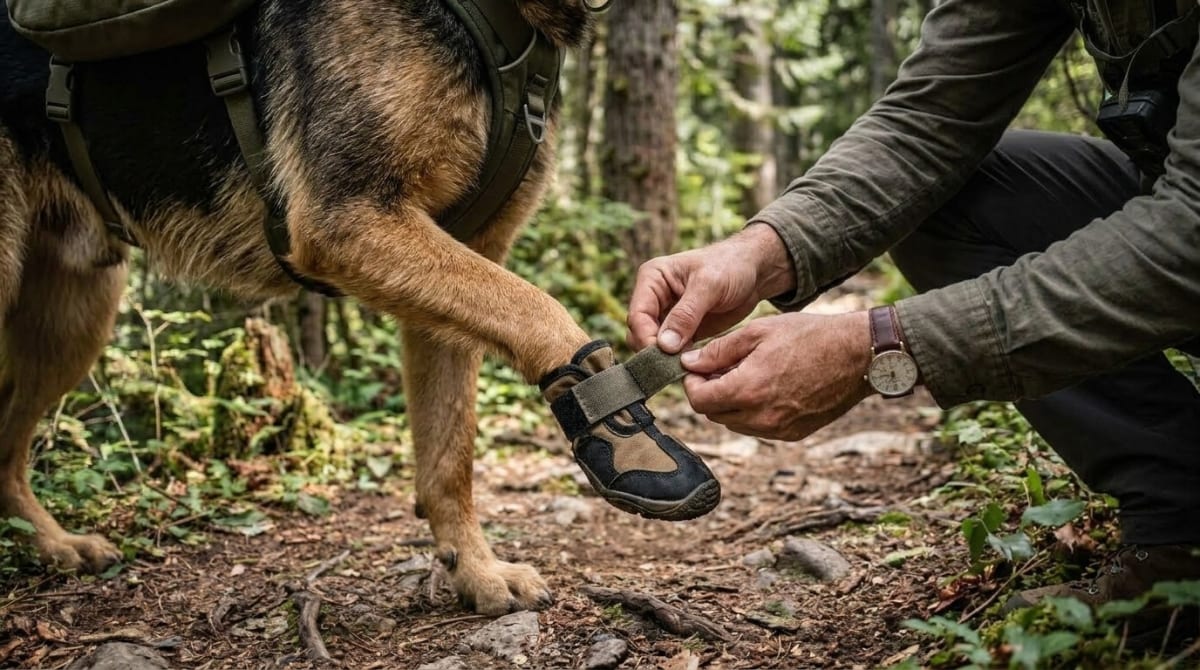
Most hikers buy one set of four dog boots and tie them on, only to lose two of them within the first mile. Dogs just do not have uniform paws. Front feet carry the weight. They are wider. When we grab a matching set of four those back boots will always be too large, forcing us to crank the straps down to dangerous tensions just to keep the things attached during a rougher hike.
Jasper is a 95-pound German Shepherd. His front paws splay out nearly a quarter-inch wider under load. If we size for his front feet the rear boots launch off on the first rocky incline. We fixed this by changing our entire sizing strategy. We measured paw splay and tested strap tension and evaluated closure hardware across fifty miles of Cascade trails. Proper fit requires measuring paws while the dog actually stands and accounting for moisture stretch.
Key Takeaways
- 1Measure paw width under load, front and back separately — they are almost always different sizes
- 2Buy boots in pairs, not sets of four — back paws typically run a half-size smaller than front
- 3The primary strap must sit below the carpal pad or the joint's own motion pushes the boot off with every step
- 4Check and retighten straps after the first mile — neoprene and mesh stretch when wet
Gear Required for Proper Fitting
Guessing paw sizes by weight causes fit failures. We need actual tools to measure the paws under load. Grab these items before ordering anything. Taking five minutes to gather the proper measurement tools prevents the absolute headache of returning muddy shoes that flew off the dog's feet during their first stream crossing and vanished into the thick brush.
- Hard tape measure
- Blank paper and a dark marker
- Self-adhering bandage wrap for dew claw protection
- Dog boots sold in pairs
Step-by-Step Guide to Secure Boot Fit
Measuring front and back paws under load is where we start. Dogs splay their toes when they stand. Lift the opposite paw to force all their weight onto the foot we want to measure. Mark the paper at the widest part of the paw on the left and right sides. Measure that gap with a hard tape measure. Do this for both front and back paws separately.
Buy boots in pairs. Sets of four rarely work. The back paws usually measure a half-size smaller than the front. We order boots sold in sets of two so the dog gets a precise fit. Buying correct sizes prevents the excess material from wadding up and slipping off during hard inclines, which is the exact failure point we noticed when we lost two rear boots in the mud on Mount Si last spring. If you are still deciding which boot to buy, our tested roundup of dog boots for rocky terrain covers the closure systems we found most reliable across 50 miles of Cascade trails.
Stiff new boots have rigid uppers that resist bending and flat out refuse to conform to the paw. We put the boots on the dog inside the house using treats to encourage walking. Do this for two days before a hike so the fabric has time to soften and mold to the foot. When the upper bends naturally with the dog's stride the boot stops fighting the strap tension and stays locked in place over rocky terrain, which dramatically kills the chances of the strap popping open when the dog scrambles over fallen logs.
Tape the dew claws before putting anything on. Friction against that claw causes dogs to kick their boots off. Take self-adhering bandage tape and wrap it twice around the leg over the dew claw. The tape flattens the claw safely against the leg while adding a textured surface that helps the strap grip the leg without sliding downward into the dirt.
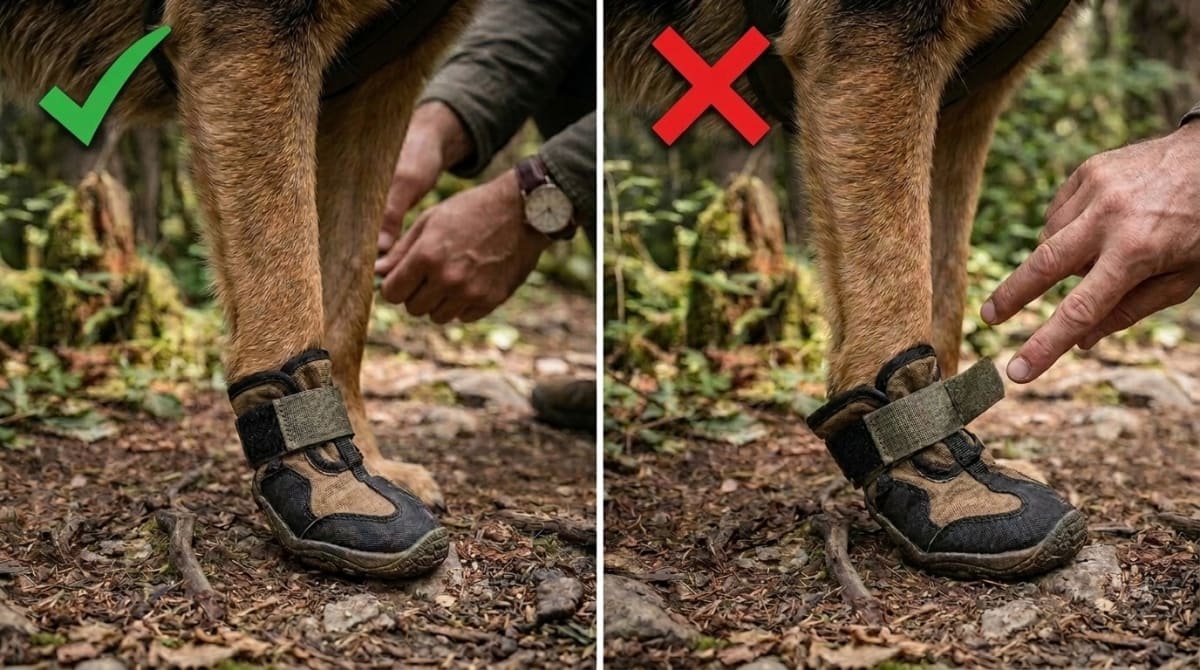
Anchor below the carpal pad. The primary strap must sit below the carpal pad to lock the whole assembly in place. Slide the paw in and feel for that small pad high on the back of the front leg. Fasten the strap directly under it. If the strap rides over the carpal pad the joint's natural motion will literally push the boot down with every single step.
Tighten the strap until we can slide two fingers under the nylon against the leg. It feels snug. If we cannot get two fingers under the material we risk cutting off blood flow.
Moisture changes everything out there. Neoprene and mesh expand when exposed to dew-soaked brush or stream water or sweat from paw pads. We stop after the first mile to check the straps. We almost always find a quarter-inch of slack that requires immediate adjustment to prevent the boot from twisting outward, because the fabric stretches under load and lets the entire paw rotate inside the rubber sole.
Common Boot Fitting Mistakes
Sizing up for easy entry guarantees failure. Many hikers buy boots a size larger just to make pulling them on easier. Loose boots twist. When a shoe twists the dog steps on the soft upper fabric instead of the rubber sole, tripping them and pulling the footwear completely off. Putting the boot on should be a struggle.
Strapping a boot directly over front dew claws causes severe friction. Dogs hate this. They will often bite the boot to stop the pain. We wrap Jasper's front legs with bandage tape before pulling his boots on. The wrap flattens the dew claw against the leg and adds texture so the strap bites into the fabric rather than sliding down the fur.
Cotton dog socks cause more problems than they solve. Cotton holds moisture against the paw. When cotton gets damp it stretches out and slides down the leg. The material pools inside the boot and physically pushes the paw out of the rubber sole. Self-adhering bandage tape works better because it bonds to itself and holds together even after repeated stream crossings, keeping the dew claw pinned safely against the leg without creating excess bulk.
Single-strap designs rarely work for large breeds on rough terrain. A 95-pound dog generates massive shear force on a downhill strike, turning single straps into a pivot point that allows the boot to rotate. Double-strap designs anchor the gear above and below the joint. Distributing the force keeps the rubber sole oriented toward the dirt. Eliminating that rotation prevents the twisting that causes dogs to lose their footwear mid-stride, which is exactly why we abandoned single-strap models after tracking several lost boots on the rocky descents of Mount Teneriffe.
Frequently Asked Questions
Kelly brings an engineering mindset to dog hiking gear. After thousands of miles with Jasper testing every harness, pack, and boot on the market, he knows what holds up and what fails.