 Paths & Paws
Most owners think Y-harnesses guarantee a dog total freedom on the trail. They don't. A 2019 Veterinary Record study actually found that a badly fitted Y-harness cut shoulder extension by up to nine degrees at a trot. That chokes off mobility worse than the horizontal chest straps researchers tested against. We learned this the hard way with Jasper. He is a 95-pound German Shepherd with a massive barrel chest and a long sweeping stride. When we hauled him up Mount Si last year, his expensive "non-restrictive" rig visibly wrecked his gait on the steep descent. The label on the box means nothing.
Whether the strap clears the point of the shoulder is all that matters. Long-legged dogs experience a fit totally differently than stockier breeds. If the neck hole sits too high on the scapula you restrict movement and invite compensatory muscle strain over a fifteen-mile day.
Key Takeaways
- 1Dogs have no collarbone, so their shoulder blades float and rely entirely on muscle, which means any strap crossing the point of the shoulder blocks its natural swing
- 2Restrictive and non-restrictive are marketing labels, not guarantees. Fit relative to your dog's specific body shape decides whether a harness restricts movement
- 3A poorly fitted Y-harness can rob up to nine degrees of shoulder extension at a trot, a worse penalty than a properly placed horizontal chest strap
- 4Proper fit has to be checked in motion, not standing still, and rechecked whenever you add pack weight or your dog's body composition shifts with the season
The Anatomy of a Dog's Shoulder
Look under the fur to see why fit actually matters. Dogs don't have collarbones. Their shoulder blades just float there. They attach to the ribcage entirely through a thick web of muscle and connective tissue. Because there is absolutely no fixed bony anchor connecting the arm to the spine, the scapula has to rely entirely on those muscles to stabilize the leg while still allowing for the massive forward reach a dog needs to scramble up rocky inclines.
When a dog walks, that blade swings wildly back and forth. The range of motion is huge. The top glides right along the side of the spine while the point of the shoulder pushes forward so the leg can reach. Drop a stiff nylon strap across that moving joint and you build a mechanical wall. The dog has to physically shorten their stride to avoid punching into the webbing.
Think of the shoulder blade as a long lever. The muscles tied to it eat the impact of landing and generate the torque needed to push up a mountain. Mess with that lever and the dog works exponentially harder.
A clipped stride might not matter on a quick neighborhood walk. Take that same tiny restriction into the Cascades for fifteen miles and it compounds into tens of thousands of corrupted steps. Muscles that should catch a break during the swing phase end up fighting the strap instead. This creates premature fatigue.
Jasper's anatomy makes him a perfect victim for bad gear. His natural trot requires massive extension. We noticed that if a strap rode even half an inch too high on his shoulder he quit reaching out with his front paws. He started taking short choppy steps to compensate. That choppy rhythm forces the hind legs to eat more impact and throws the whole kinetic chain into chaos.
The Myth of Restrictive versus Non-Restrictive Labels
The outdoor industry loves dumbing things down. Horizontal chest straps get boxed as restrictive. Y-shaped chest straps get sold as non-restrictive. The field data tells a completely different story.
A 2023 Journal of Applied Animal Welfare Science paper tracked sixty-six dogs running in various setups. Researchers proved that fit beats category every single time. Take horizontal chest straps on Labrador Retrievers or Springer Spaniels. Because those specific breeds have long legs compared to their height at the withers, the horizontal strap sat cleanly below the shoulder joint. It cleared the moving parts entirely.
Meanwhile the holy grail Y-harnesses actually choked off stride length in dogs when the neck opening ran a bit too small. If that Y shape creeps up, the fabric parks directly on top of the scapula. It might look like a Y from the front, but from a side profile it pins the shoulder blade to the ribs just as aggressively as a straight strap.
That 2019 Veterinary Record study quantified this using high-speed treadmill video. Dogs walked while researchers tracked their extension angles. Baseline without gear showed full reach. Horizontal chest straps caused a two to five degree penalty in extension. But poorly fitted Y-harnesses robbed the dogs of up to nine degrees of extension at a trot. Losing nine degrees creates a brutal biomechanical handicap that drains a working dog with every single step they take on dirt.
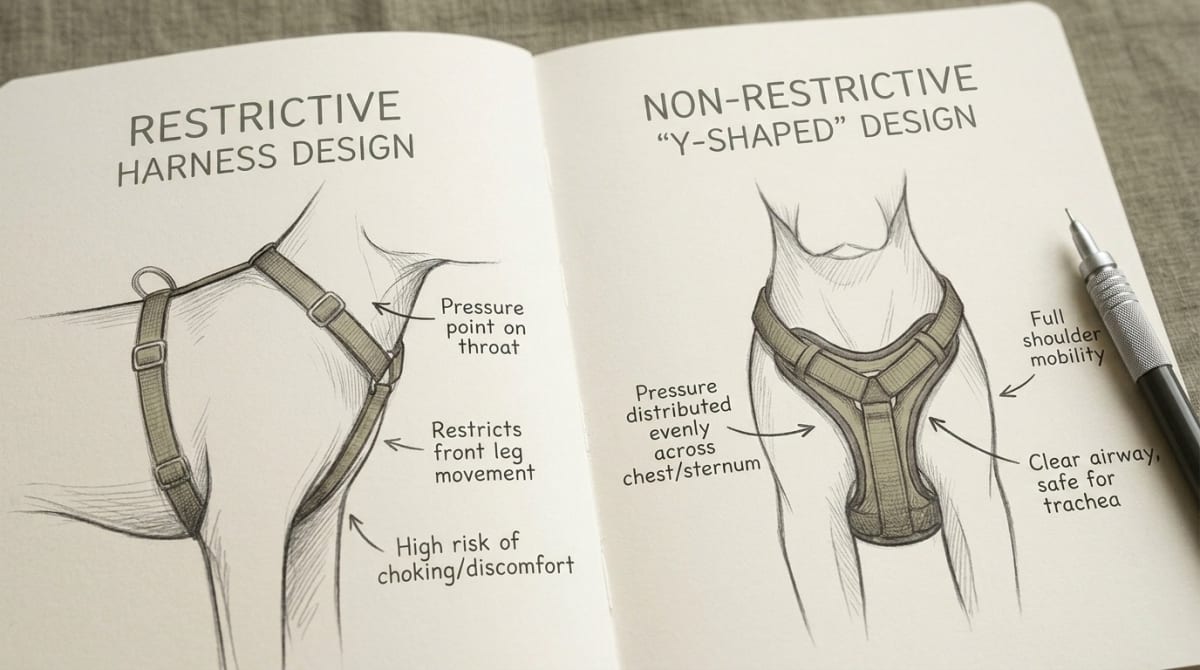
We forced Jasper through this exact failure. We dropped cash on a popular multiday Y-harness. His deep chest pushed the neck straps way higher than the manufacturer intended, meaning every time he reached forward his shoulder blade slammed into padded webbing. We had to dig his old harness out of the truck halfway up the trail. A magically non-restrictive setup does not exist on a store shelf. You have to tweak the straps yourself until they physically clear the joints.
How to Identify and Achieve a Proper Fit
Getting this right takes manual work. You cannot evaluate a fit while a dog stands still in your living room. You have to watch the straps under tension while they move.
Start by locating the point of the shoulder. Run a hand down the dog's neck until you hit a hard bony lump at the front of the chest. That marks where the shoulder blade ties into the upper arm bone. Your structural webbing needs to sit behind or below this exact joint. If any piece of the front chassis crosses over that lump you are blocking movement.
Look at the neck opening next. The Y-shape has to center dead on the sternum. The top straps must rest down at the base of the neck. Slide two fingers under the fabric and have the dog pull forward to check the tension. If you see the center ring slide up toward the throat under leash tension, the neck opening is set too large. When that front chassis rides up it drags the side webbing straight into the path of the dog's shoulder blade and creates an immediate physical wall.
Check the armpit clearance. The girth strap needs to ride far enough back to prevent raw chafing behind the elbow but close enough to stay off the soft stomach tissue. We aim for three to four inches of daylight behind Jasper's front legs. That pocket lets the elbow flex completely without shoving the front assembly out of whack.
Adding saddlebags makes this process far more brutal, especially once you're loading them anywhere close to a dog's safe pack weight limit. The bags have to be perfectly balanced so they don't drag the center chassis sideways. A lopsided load pulls the neck opening over the shoulder blade on the heavy side, creating a unilateral block that will give a dog a severe limp after just a few miles on trail.
Film the dog trotting. A trot is a symmetrical two-beat gait where diagonal legs move in unison, and it demands way more shoulder extension than a standard walk. Record a side profile of the dog trotting bare, then film them wearing the loaded pack. Watch the playback. Look at the exact point where the front paw touches dirt. If that reach gets noticeably shorter with the straps on, you need to adjust the sizing or scrap the design entirely.
The Long-Term Consequences of Poor Load Distribution
Hiking with a pinned shoulder forces a dog to adapt on the fly. They can't just quit the hike, so they alter their biomechanics. They start lifting their legs vertically instead of reaching out forward. That upward compensation asks entirely different muscle groups to do the heavy lifting.
The short-term penalty is a dog that burns out early. The long-term reality looks like chronic wear and tear. When the front legs chop their stride short, the spine has to eat more rotational force just to keep the dog's momentum moving forward. That gets sketchy fast on loose scree or root-heavy trails where footing is already a gamble.
Veterinary data points to chronic gait alterations as a fast track to repetitive strain injuries in the soft tissues holding the shoulder together. A chopped stride even screws up how the paw hits the dirt. Instead of a smooth landing on the pads, a dog might punch harder into the ground on their toes. We caught this exact breakdown during our early hiking days. Before we figured out biomechanics, Jasper ran in a sloppy vest. We pulled his boots off after ten miles and saw brutal wear on his front two toenails. He was literally digging into the dirt to compensate for a trapped shoulder.
Fixing the gear cleared the problem that same day. His stride opened up. His paw strikes leveled out immediately. We watched his stamina on long ascents jump noticeably.
Common Mistakes When Sizing Trail Gear
The most common trap is sizing up just to get thicker padding. Beefy padding feels great to human hands, but wide straps are a nightmare to route around a dog's moving joints. A thin and pliable strap that drops into the correct anatomical groove will always beat a heavily padded strap that blocks the bone.
Check the hardware linking the straps. Massive plastic buckles sitting too close to the shoulder joint will bruise the underlying tissue even if the strap itself clears the bone. Metal hardware runs thinner and sits flatter against the ribs, which drops the risk of friction burns on steep descents. We break down exactly this kind of hardware placement in our full test of the Ruffwear Switchbak harness.
People constantly forget to adjust the rigging for pack weight. If a dog carries their own gear, that weight forces the assembly downward. A fit that looks flawless in the kitchen will sag straight into the shoulder joint the second you drop kibble and water bottles into the bags. Run your final fit check with the pack fully loaded.
Finally, owners rarely tweak gear once a dog hits full size. A dog's body composition shifts with the seasons. Jasper burns off fat and packs on muscle during peak summer hiking. We have to crank his girth strap down in July and let it out in November. Run a loose girth strap and the whole setup rotates. That pulls the front Y-piece straight into the shoulder on the pulling side. Check the fit at the trailhead every single time you hike.
Frequently Asked Questions
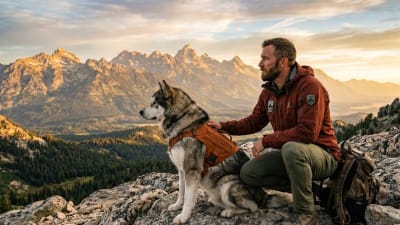
Kelly brings an engineering mindset to dog hiking gear. After thousands of miles with Jasper testing every harness, pack, and boot on the market, he knows what holds up and what fails.
References & Further Reading
- Effects of restrictive and non-restrictive harnesses on shoulder extension in dogs at walk and trot — Veterinary Record (2019)
- Effect of harness design on the biomechanics of domestic dogs (Canis lupus familiaris) — Journal of Applied Animal Welfare Science (2023)