 Paths & Paws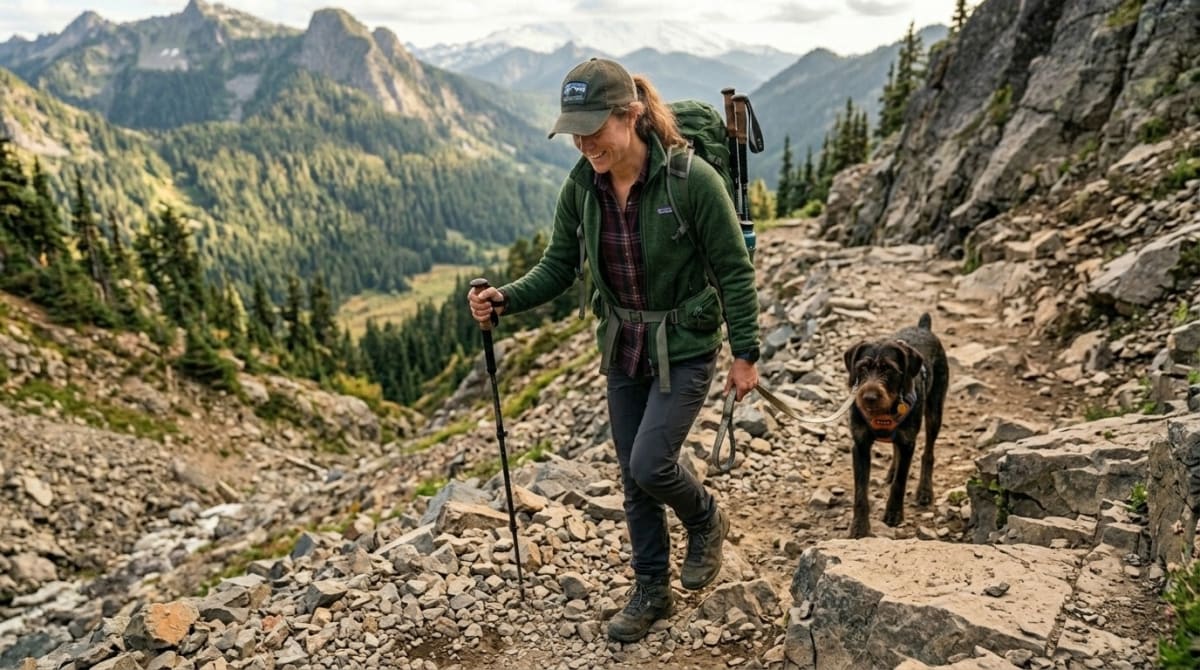
A pulling dog is rarely just excited. They are fighting gravity. A fifty-pound dog carries sixty percent of body weight on their front legs and that braking load spikes dangerously when the dirt points down. When we first started tackling descents in the Cascades, my fifty-pound Lab mix rescue named Scout would hit the end of her six-foot leash with enough force to rip me off my feet. We stopped trying to hold her back with pure arm strength. We taught the behind command instead.
Teaching a dog to walk in the rear changes the mechanics of a drop. Our bodies become the solid barrier regulating the pace. This forces the animal to match human speed. We trained this over four weeks, starting in our driveway before taking it out to the Mailbox Peak trail. The whole process takes high-value treats and a standard fixed-length leash along with an absolute, unwavering refusal to take a single step forward when the dog decides to break their position.
Key Takeaways
- 1Dogs pull downhill because gravity shifts their center of mass forward onto already-stressed front joints, making a fast trot feel better than a slow walk
- 2The behind command works by using your body as a pacing barrier, forcing the dog to match your speed instead of fighting gravity independently
- 3Always build the foundation on flat, boring ground first. Do not take this training onto a real trail until the dog can hold position for fifty yards without breaking
- 4Keep leash tension slack (J-curve shape). Tight constant tension triggers the opposition reflex and makes pulling worse, not better
The Biomechanics of the Downhill Pull
Why do dogs speed up when the trail drops? Physics takes over. Knowing how canine movement actually works helps fix the pulling. On flat ground, a dog's center of mass sits just behind the shoulders. A 2010 study in the American Journal of Veterinary Research measured canine walking kinematics, tracking exactly how weight distribution and joint angles change across different slopes to understand the muscular toll of descent. Gravity pulls that center of mass forward the moment a dog steps onto a decline. Front legs eat the shock. Walking slowly down a hill demands tremendous shoulder strength and core stability from an animal, so they naturally find it easier to bump their speed and transition into a trot. Letting momentum take over simply hurts less than fighting gravity with every step.
This builds a nasty feedback loop out there. The dog speeds up to relieve the strain on those front joints. We pull back on the leash to slow them down. That tension on the harness shifts canine weight even further forward which makes them feel off-balance and triggers even harder pulling. Teaching the behind command breaks this cycle. When walking in the rear position, dogs use us as a pacing guide to maintain a controlled rhythmic walk without panicking over the steepness of the grade.
What You Need
This command takes different gear than a casual neighborhood stroll. We found the equipment needs to give precise control while keeping the dog comfortable during the early learning phase.
- A four-to-six-foot fixed-length leash. Retractable models or long lines are garbage for this. A static line transmits weight shifts instantly so we stick to a standard six-foot nylon leash with a padded handle.
- A well-fitted walking harness. Never teach this using a neck collar. A dog making a mistake and pulling past the handler will just get choked by a collar, increasing their panic, while a Y-style harness distributes the braking force safely across the chest.
- High-value soft treats. Kibble fails here. Dogs need treats they can swallow instantly without stopping to chew. We chop hot dogs or string cheese into pea-sized bites.
- A treat pouch. Timing dictates everything. Rewards must land within one second of the dog hitting the correct position. Fumbling in jacket pockets ruins that window completely.
Step-by-Step Teaching
Do not start this training on a mountain trail. We built the foundation on flat, boring ground where distractions basically don't exist.
Start the flat ground positioning in an empty parking lot or our personal favorite, a quiet driveway. Walk forward with the dog on a short leash while holding the line in the right hand. Take a treat in the left hand and lure the dog right behind the legs. Say the word "behind" exactly once. The exact moment their nose crosses behind the knee, praise them and drop the treat right at their paws so they learn to look at the dirt instead of staring up at you. Dogs staring up at hands will absolutely trip you on a descent.
Move to a one-step drill next. Take exactly one step forward. Most dogs naturally try to step ahead to return to their normal cruising position. Use the leash to gently block them from passing the leg. Deliver another treat the second they settle behind the knee again. Repeat this one-step drill ten to fifteen times. Scout fought this phase. She always wanted to lead. We spent three days grinding the one-step drill until she realized the area behind my knees was the only spot payouts happened.
Progress to continuous movement on flat ground. Begin walking at a slow steady pace. Keep the leash short enough that the dog cannot physically pass the leg. Drop a treat behind every three steps without stopping forward momentum. Stop walking immediately if the dog tries to push past. Turn around and reset them in the rear position before starting to walk again. Never let a forward lunge result in forward progress. Muscle memory has to lock in here before you introduce any kind of elevation change.
Transition to a slight incline once the dog can hold position for fifty yards on the flat. We usually find a small grassy hill at a local park. Start walking down the hill. Gravity will tempt the dog to speed up and you have to become an absolute brick wall. Hold that ground. Stop dead if they break position. The human body literally blocks their path and the descent only resumes when they willingly step back behind the legs. Reward heavily. A gentle slope introduces the sensation of braking without the high stakes of a mountain drop.
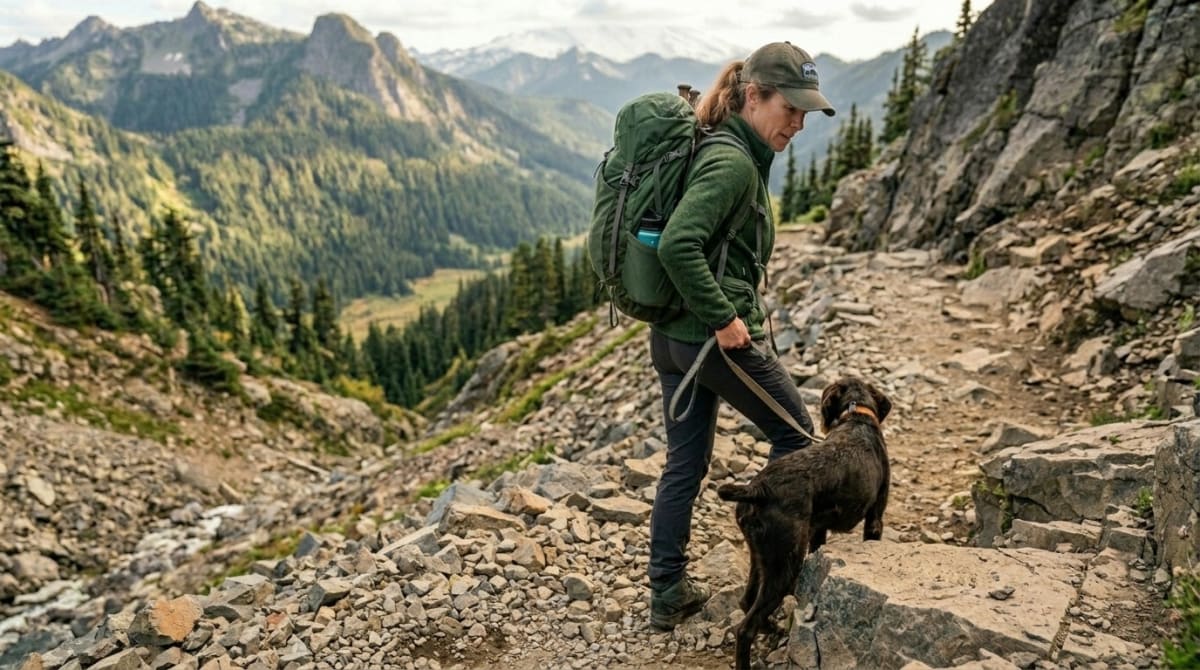
Take the training to a real hiking trail with a moderate decline to manage the leash in real conditions. Keep those sessions under ten minutes. A dog walking slowly downhill is actually performing intense isometric exercises with their hind legs which tires them out incredibly fast. Scout would get sloppy after about five minutes on the Mount Teneriffe descent. We keep the leash locked at the hip when hitting vertical drops. I step down. I wait for her to follow behind me. We proceed methodically from there. We act as the anchor point while the animal figures out their footing. Watch for the same early signs of physical fatigue you'd track on any long day out — see when dogs show signs of being too tired to continue, since downhill isometric work drains them faster than flat miles.
Nobody wants to drop cheese on the trail forever. Fading the rewards is the final step. Start randomizing the rewards after two weeks of success on real trails. Drop a treat after ten steps, then maybe after three, then twenty, and finally after a full minute of walking. Dogs stay in position because they never know exactly when the next payout occurs. Verbal praise eventually becomes the primary reward and food only comes out for the most technical slippery descents.
Common Mistakes Managing Strong Pullers
Dogs will test the rules when the environment gets exciting or the trail drops drastically, even with a solid foundation. We've seen many hikers make handling errors that accidentally reinforce the pulling.
The most frequent mistake is the slow yield. The dog pulls ahead, and instead of stopping, the handler slows the pace but keeps shuffling forward. This teaches the dog that pulling still works. It just requires more effort on their end. The rule must be absolute. All forward motion dies if the dog passes the knee. Do not take half a step. Stop like you hit a brick wall.
Another major issue we see is improper leash tension. Hikers getting nervous on a sharp descent will unconsciously wrap the leash around the wrist and pull upward, creating constant tight tension. Dogs have an opposition reflex. Pulling back causes them to instinctively pull against the hand. The leash needs a slack J-shaped curve. The line should only go tight if the dog makes a mistake. The line must stay slack if they walk nicely behind.
Owners also tend to fade the treats way too quickly because they underestimate how much downhill walking mechanically drains a dog since the animal is working so hard to fight their inherent momentum. They need payment. We kept a high rate of reinforcement going for three full months. Even today, if we hit a particularly treacherous section of scree on a descent, we will drop a piece of cheese every ten feet to keep Scout focused and completely in position. Dogs who already struggle with trail impulse control often need this kind of extended reinforcement schedule — the same approach we use for managing reactive dogs on trail.
Frequently Asked Questions
Filed under
Sarah is learning to hike with dogs alongside her readers. Scout is her first trail companion, and she shares every mistake, success, and lesson learned along the way.