 Paths & Paws
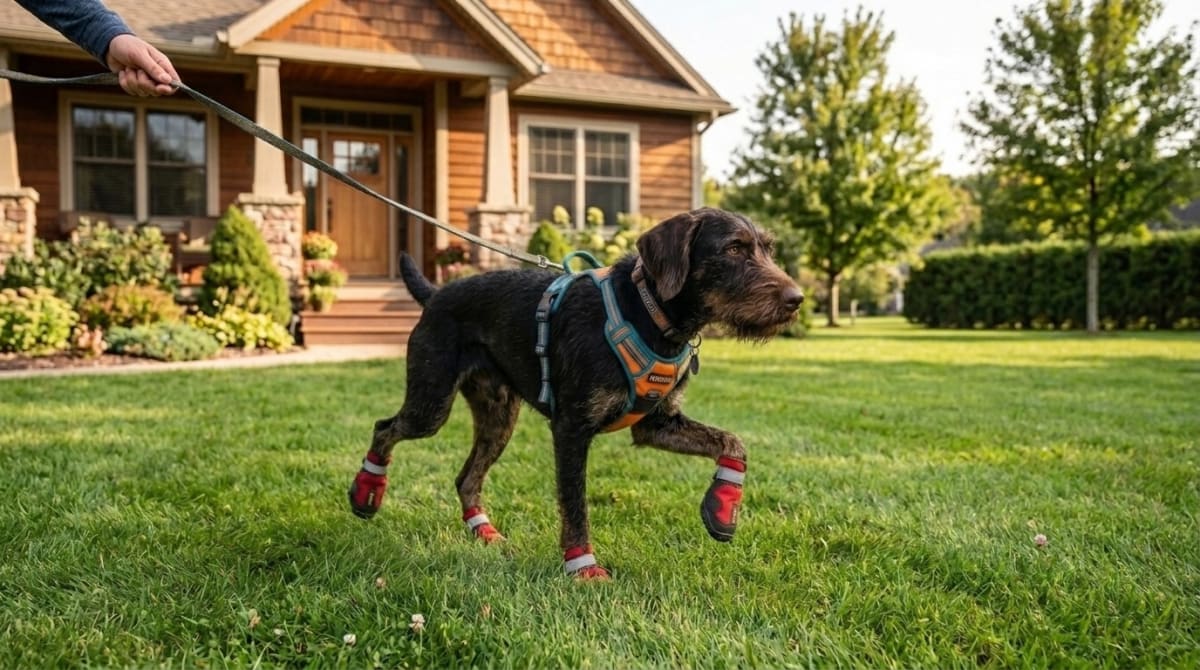
You just blinded their feet. That's exactly what happens when you strap boots on a dog for the very first time. A 2022 veterinary study tracked how covering paw pads alters a dog's center of pressure and strips away the sensory feedback they need to balance, forcing them into that hilarious but unstable high-stepping walk you always see in viral videos. We somehow expect our dogs to hike 10 miles over sharp granite in brand new footwear. This never works. If you skip the training phase, you guarantee those boots end up lost in the brush.
Key Takeaways
- 1Boots block sensory receptors in paw pads, triggering the high-stepping walk dogs use to navigate perceived obstacles
- 2A 2022 veterinary study confirmed boots shift a dog's center of pressure, requiring them to learn an entirely new way to balance
- 3Start with front boots only - dogs carry 60% of their weight up front and adapt faster when their back legs stay bare initially
- 414 days of gradual indoor-to-trail training eliminates the funny walk before your first real hike
Why They Walk Funny
When we first brought boots home for Scout, our 50-pound Lab mix rescue, she just froze. Then she kicked her back legs like a bronco. We definitely laughed. Scout was actually dealing with a massive disruption of the neurological signals that allow her to navigate sketchy terrain without falling during a steep descent.
Dogs read the trail through their feet. Those pads are packed with sensory receptors constantly firing data back to the brain about ground texture and temperature. We call this system proprioception. It acts as a continuous feedback loop telling a dog exactly where their limbs are in space at any given millisecond, keeping them upright when jumping over deadfall or scrambling up slick rock faces.
A thick rubber sole covering those pads cuts off the data stream. The brain panics. It literally cannot feel the floor. To compensate for the sudden numbness, the central nervous system tells the legs to step high to clear perceived obstacles. The dog thinks they are walking through deep mud or lifting their paws over invisible hurdles hidden in the brush, forcing that exaggerated gait until they get visual confirmation the path is actually clear.
Boots also wreck their natural weight distribution. A 2022 study in Frontiers in Veterinary Science tested this exact problem. Researchers tracked dogs walking over pressure plates with and without boots, discovering major shifts in center of pressure and vertical force across the front limbs where dogs carry most of their mass during a typical walk. They have to learn an entirely new way to balance.
The funny walk is just a symptom of a broken navigation system. They step high to avoid tripping. They kick out their back legs to shake off the foreign object. You have to resist the urge to pull the boots off immediately when they start kicking, because their brain requires consistent active movement to rewrite its internal balance protocols and adapt to the stiff soles.
What You Need
We recommend gathering four basic items before starting. Get this gear together before you begin the desensitization process, keeping in mind that treat quality directly determines how willing a dog is to push through the initial discomfort of losing their ground feel.
- A set of dog boots sized for both front and back paws
- High-value treats like hot dogs or cheese cut into pea-sized pieces
- A quiet room with carpet or a non-slip rug
- Two weeks of training time
The 14-Day Boot Training Progression
You absolutely cannot rush this. Strapping boots on at the trailhead just causes panic. Follow this timeline to build solid tolerance. Dogs need a gradual introduction that separates the weird sensation of wearing shoes from the physical exertion of a long hike, which is exactly why our trail tests point to a structured fourteen-day progression.
Step 1
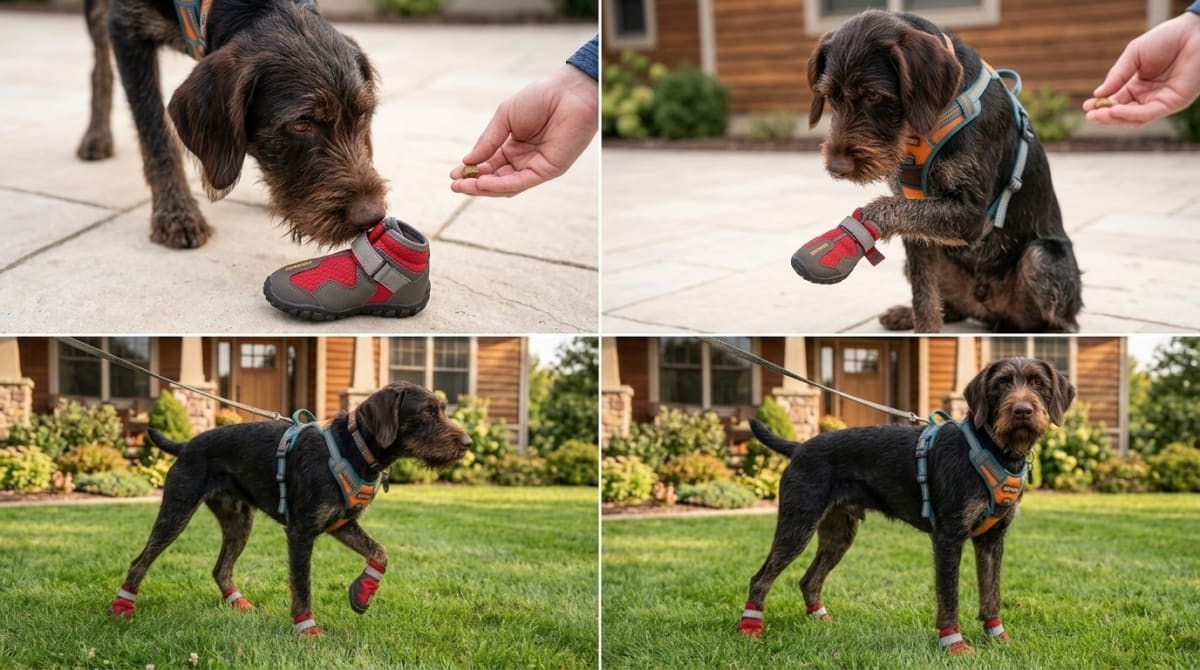
Don't put the boots on yet. Leave them on the living room floor near the food bowl for the first two days. Let the dog sniff the rubber. Hand out a treat every time they inspect the footwear. The goal is making the boots signal that food is coming, building a positive association long before you ever attempt to slide a restrictive strap over their sensitive paw pads and dewclaws.
Step 2
Dogs carry roughly 60 percent of their body weight up front. Leave their back legs bare. This helps them maintain balance during the initial shock. Slide boots onto the front paws only on day three, hand over high-value treats to distract from the footwear, and coax the dog to take two or three steps forward across the carpet. Take them off after two minutes. Repeat this daily through day five.
Step 3
Add the back boots on day six. Scout really struggled here until we realized her back paws were actually smaller than her front ones. Dogs often need a smaller size for their hind legs. Put all four boots on and start a training game. Ask for a sit. Toss a piece of cheese across the room, because sudden movement forces the brain to process the new weight distribution and keeps the dog from freezing in place out of pure confusion. Keep these sessions under five minutes until day eight.
Step 4
Take the training to the backyard or a familiar sidewalk by day nine. The outside world offers way better distractions. Let them sniff trees and grass. The varying terrain helps those paws adjust to different ground pressures. Walk for ten minutes. Watch closely for any signs of chafing around the dewclaws or ankle joints, as friction injuries can flare up in minutes when stiff boot materials rub against bare skin during this early adaptation phase. Continue this daily routine through day eleven.
Step 5
Drive to a local park or an easy dirt path by day twelve. Hike for just one mile. You want to test the gear under mild conditions before committing to a remote trailhead. We tested this exact approach with Scout on the lower sections of Mount Si in the Cascades, where the mixed terrain provided enough challenge to properly evaluate the boot grip without exhausting her. She hiked happily for two miles. The high-stepping disappeared by the second switchback.
Common Mistakes and When to Quit
Most owners fail because they force the issue. They wrestle boots onto a panicking dog and drag them down the sidewalk. This ruins the gear association. Dogs who get forced into uncomfortable equipment while dealing with sensory deprivation will learn to run away and hide under the bed the moment you pull your hiking pack out of the closet.
Sizing is another huge trap. Boot straps must sit tight enough to prevent twisting. But overtightening cuts off circulation. You should be able to slide a single pinky finger under the strap. If the boot rotates sideways after three steps it is too large. Some brands sell boots in sets of two because front and back paw widths rarely match, forcing you to buy different sizes just to achieve a secure fit across all four legs.
Sometimes you just need to accept that boots are the wrong gear choice. You should persist if the dog walks funny but still takes treats and follows commands. The high-stepping phase always passes. But a dog in full panic won't learn anything. If they frantically bite at the straps or cower on the floor you are doing way more harm than good. When a dog reaches that level of distress their brain stops processing new information, meaning any further attempts to walk will only reinforce their fear of the footwear. Stop the session right there.
Take a hard look at the actual trail conditions. Boots are non-negotiable for sharp volcanic rock - see our dog boots for rocky terrain guide if you need help picking a durable pair. But if you just want protection from hot pavement or minor ice buildup, skip the rigid footwear entirely. A high-quality paw wax provides excellent temporary protection against heat and ice without triggering the sensory loss that causes the funny walk in the first place. We break down when wax outperforms boots in our dog boots vs. paw wax comparison. You can hit the trail today instead of waiting two weeks.
Frequently Asked Questions
Sarah is learning to hike with dogs alongside her readers. Scout is her first trail companion, and she shares every mistake, success, and lesson learned along the way.
References & Further Reading
- Changes in Ground Reaction Forces and Center of Pressure Parameters of Paws When Wearing Dog Boots in Dogs. Front Vet Sci 2022 — Frontiers in Veterinary Science (2022)