 Paths & Paws
Puppies cannot handle real hiking until their growth plates fully close between twelve and eighteen months of age. We scrapped our early plans with Scout. You must wait. Pushing a pup through forced miles on developing joints risks permanent damage, meaning those big mountain weekend trips need to go on hold while the newest member of the family physically matures and builds up some baseline strength.
Key Takeaways
- 1Small breeds close growth plates around 10-12 months; large breeds need 14-18 months; giant breeds up to 24 months before real trail mileage
- 2The 5-minute rule: 5 minutes of continuous leashed walking per month of age, twice daily. A 4-month-old gets 20 minutes max
- 3Free play off-leash is safer than forced marches - puppies control their own output and rest when tired rather than being pulled forward by the leash
- 4Never load a pack before 18 months. Even an empty harness changes gait mechanics and shifts load onto joints that aren't finished hardening
Why Growth Plates Dictate Trail Readiness
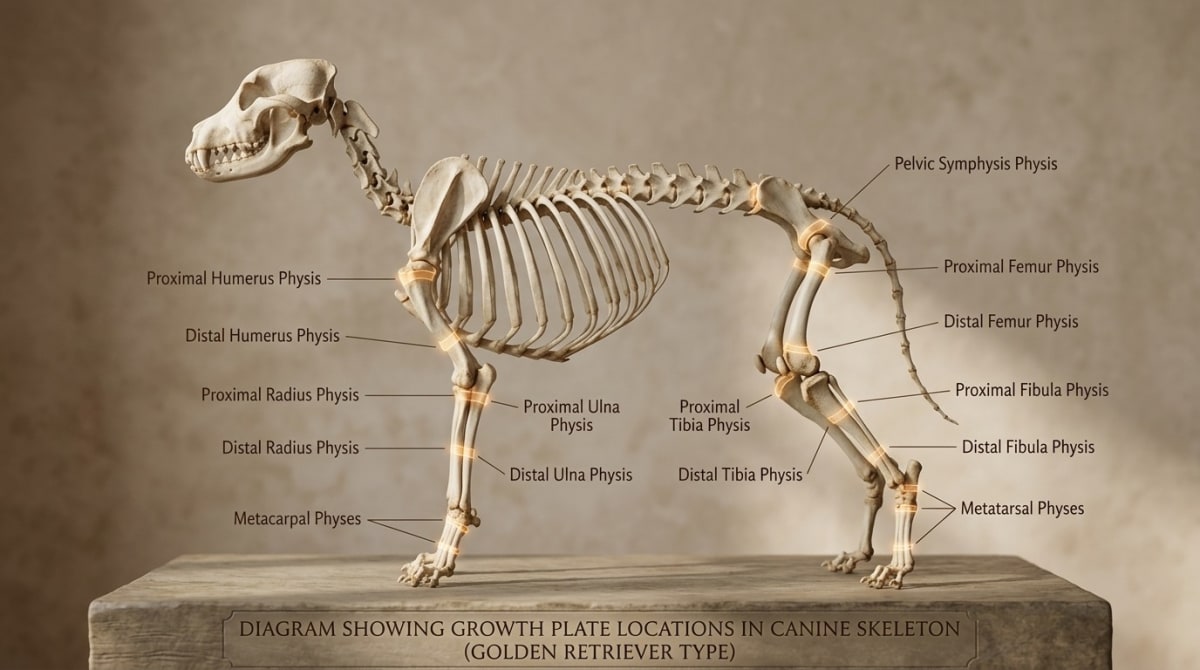
Growth plates are soft cartilage zones at the ends of leg bones. They let the skeleton expand as the animal gets bigger. These zones consist of soft tissue instead of hardened calcium, leaving them highly exposed to repetitive shock. A bad landing crushes cartilage cells. Endless marches on packed dirt wreck the tissue. This unseen trauma halts bone development prematurely. Crooked legs happen. Arthritis sets in early.
Every breed runs on a different biological clock. Small dogs finish up faster. Their skeletal development usually wraps around ten to twelve months of age, but if you brought home a large breed like a German Shepherd or Golden Retriever, expect to wait fourteen to eighteen months for full maturity, while giant breeds often need two solid years to finish growing.
When we adopted Scout as a fifty-pound rescue, we figured her moderate size meant she was good to hit the woods right away. We were dead wrong. A 1997 study in the Journal of the American Veterinary Medical Association tracked Labrador Retrievers and found their primary growth plates take well over a year to finish closing and calcifying into solid bone. The researchers monitored joint mineralization over time to map out safe development windows. That data changed how we approach the outdoors. You cannot rush biology. Ligaments stretch. Cartilage compresses. You have to let the skeleton finish building itself before you subject it to miles of root-covered terrain and heavy pack loads.
The 5-Minute Rule for Distance
Most vets rely on a simple calculation called the five-minute rule to cap early activity levels. For every month of age, a pup can safely handle five minutes of continuous walking twice a day. A four-month-old gets twenty minutes. A six-month-old tops out at thirty minutes per session.
Let the clock dictate the outing instead of checking the GPS mileage. At a normal human walking pace, thirty minutes barely covers a single mile of trail. This restriction specifically targets forced exercise. That happens whenever a person dictates the pace and direction on a leash, pulling the dog forward and preventing the animal from just stopping or flopping down in the dirt to rest when they feel gassed.
We applied this strictly when conditioning Scout around our local neighborhood loops. We timed every walk. We ignored the distance completely. Marching a puppy for three miles down a flat logging road does more hidden physical harm than letting them sprint like a maniac around a grassy park for an hour, because sustained, straight-line stress tires out the supporting muscles and dumps all the impact directly onto those developing joint plates.
Safe Conditioning Exercises for Puppies
You can still build up trail fitness without breaking the time limits. The trick involves swapping forced marches for self-regulated wandering. Free play lets a puppy completely control their own output. They sprint. They tumble. They collapse in the grass when they get tired.
Take a juvenile dog out to a wooded area and practice off-leash recall in an open meadow. Let them navigate over small logs at their own pace. We brought Scout to the Rattlesnake Ledge trailhead just to sit on a stump and watch other hikers walk by, which let her learn the sights and smells of the forest without bearing any physical burden at all.
Introduce different ground textures early. Let them navigate packed dirt and smooth river rocks during those allotted twenty-minute sessions. Swimming builds incredible cardiovascular fitness with zero joint impact. It makes the perfect outlet for high-energy working breeds who desperately need to burn off mental frustration while waiting for their bones to finish hardening up. Brain work tires a puppy out much faster than physical exertion anyway. Ten minutes of basic obedience training on a wilderness path drains more energy than a mile of mindless pavement walking. Once the growth plates close and your pup graduates to full trail days, our guide on building up to a 10-mile hike walks through the 8-week conditioning plan that gets most adult dogs there safely.
Frequently Asked Questions
Sarah is learning to hike with dogs alongside her readers. Scout is her first trail companion, and she shares every mistake, success, and lesson learned along the way.