 Paths & Paws
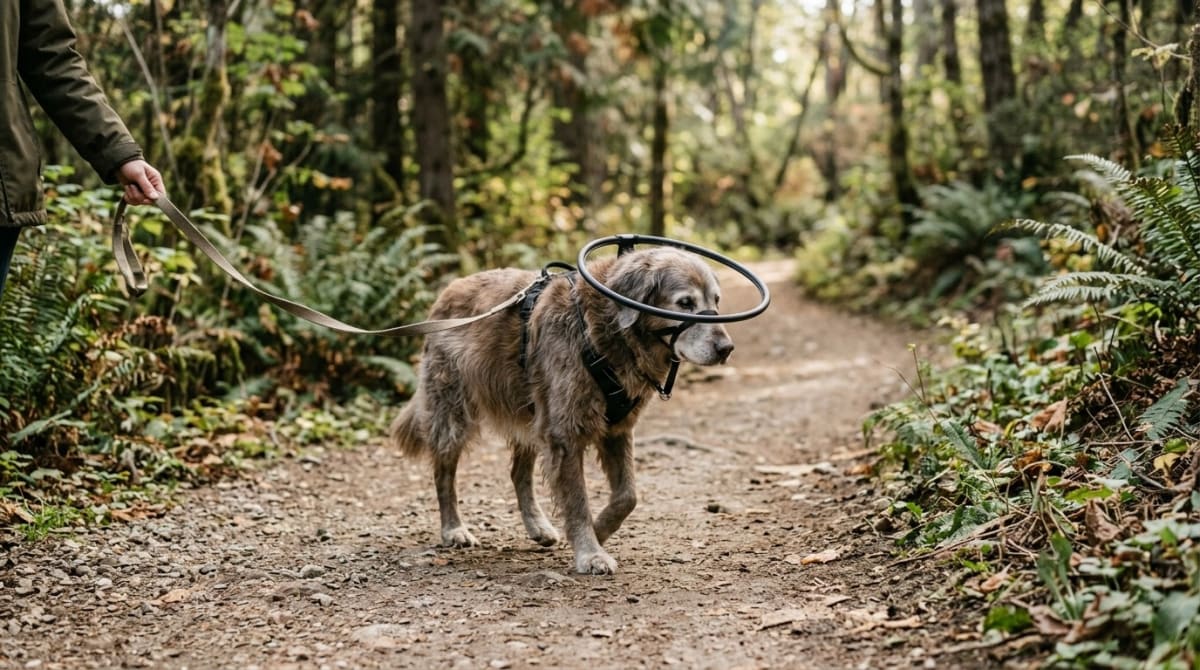
Most people assume a visually impaired dog belongs on the couch. They are wrong. When my 50-pound rescue Lab mix, Scout, got a nasty eye infection that wiped out her vision for a while I really thought our hiking season was done. But a 2013 study in the Journal of the American Veterinary Medical Association tracking sudden retinal degeneration actually found most owners report moderate to excellent quality of life as long as daily routines hold steady. Dogs map the world through their noses. They build terrain models from scent and texture. That means they can still crush complex outdoor miles if we step up to act as their eyes. We just have to alter how we talk to them. Tactile signals and smart trail choices make a massive difference.
Key Takeaways
- 1Skip technical singletrack for wide, predictable paths with obvious borders and stick to a familiar route until the dog builds a solid scent map
- 2A structured Y-harness with a rigid back handle gives far better obstacle feedback than a collar, which risks airway injury if the dog trips forward
- 3A four-foot fixed leash acts like a telegraph wire, so a tiny upward tug signals slow down while a loose J-shape confirms the path ahead is clear
- 4Let the dog bump into small roots and rocks on its own since carrying it over every obstacle prevents the spatial mapping skills it needs to build confidence
Trail Selection for Blind Dogs
Skip the technical singletrack. The goal is predictable footing with obvious borders. A sighted dog scans the path ahead. A blind dog feels the hard dirt end and the soft grass begin.
Look for wide multi-use paths or flat converted rail lines for those first few outings. Gravel actually gives fantastic acoustic and tactile feedback. Stay away from thick root clusters, sharp drop-offs, deep mud pits and any route crossing water. Flowing water completely masks a scent map and drowns out the auditory cues needed to guide them safely. That severely disorients an animal relying totally on non-visual inputs.
Familiarity builds confidence. Scout totally exhausted herself in just two miles the first time we tried a new route. The sheer mental drain required to process strange terrain and build a brand new mental map from absolute scratch burned her stamina way faster than climbing a steep grade ever did. We hit that exact same trail three days later and she trotted four miles with a completely loose body. That initial scent map was already locked in. Keep hitting the same local spot until they figure out the new normal.
Essential Gear for Vision-Impaired Dogs
A standard collar is useless here. It gives terrible tactile feedback. There's also a risk of serious airway compression if the dog trips and falls forward.
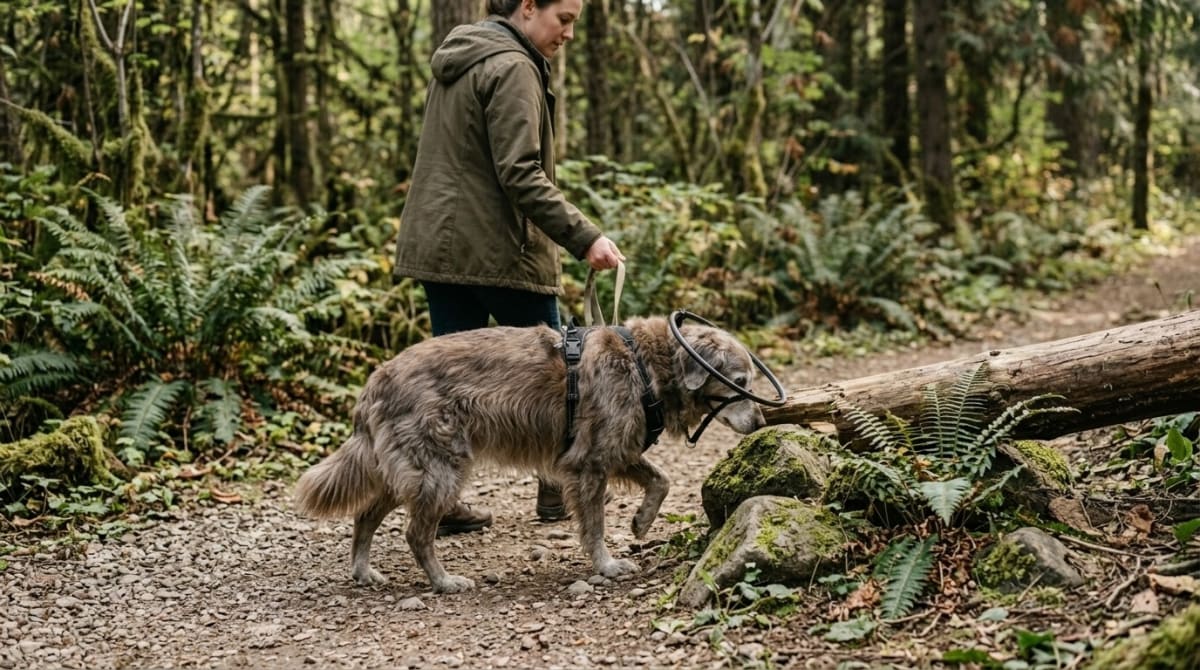
The better move is a structured Y-harness with a stiff padded handle right on the back. Scout has this deep barrel chest that causes normal gear to twist sideways under any tension at all. We swapped to a rugged harness that stays totally locked down. Think of that back handle as a joystick. When we walk up to a massive step or a deep puddle or some downed timber blocking the route I just pull straight up on the handle to lift her front end slightly. That directly signals the obstacle before she can crash into it.
Halo harnesses are another common choice. A 2020 study in the Journal of Small Animal Practice actually showed these barrier devices reduce maze collisions for blind dogs pretty significantly. These bumper rings attach to a vest and stick out past the face. They work brilliantly on wide gravel roads. They get maddening on narrow trails because the wire loop constantly snags on low brush and jagged rocks.
How to Guide a Blind Dog Through Obstacles
Guiding takes active work. A handler can't just zone out and drag the lead.
Drop the retractable leash immediately and grab a four-foot fixed line instead. That shorter length is necessary to maintain consistent tension since the leash acts like a telegraph wire between the hand and their harness. A tiny upward tug tells the dog to slow down while a loose J-shape confirms the path ahead is totally clear.
The dog can't track your movements visually anymore so attach a tiny bear bell right to a shoe. That steady jingling provides a continuous sound target for them to track. It works wonders for keeping them from drifting off the trail edge.
Building a rock-solid command dictionary is next. Dogs pick up positional words fast. We rely on "step up" for logs and "step down" for ditches. Our wait command drilling means "wait" triggers an instant freeze. The trick is saying the verbal command exactly one second before applying direct harness pressure. That tiny delay gives the dog's brain just enough time to process the spoken instruction before their body feels the movement.
When approaching a narrow footbridge or a nasty drop-off the handler needs to physically step between the dog and the hazard while keeping that leash short enough to control their center of gravity. Use your leg as a literal bumper to shove them gently away from the edge.
Common Mistakes on the Trail
Over-protecting the dog usually ruins the hike. Owners get nervous and pull the leash completely taut for miles at a time. Constant tension kills your ability to talk through the lead. A warning tug means absolutely nothing if the line is already stretched taut. Slack on flat ground is mandatory so the dog learns to relax their shoulders and read the dirt under their feet.
People also tend to carry their blind dogs over every minor obstacle. Stop doing this. Let them figure out small roots and rocks on their own. They literally need to bump into minor obstructions to learn how to get around them. Panicking and scooping the dog up the second the trail gets slightly uneven shatters their confidence and prevents them from developing the exact spatial mapping skills they desperately need. Just guide them to the log or rock. Give the spoken cue. Let them feel it out with their paws.
And please don't hike in dead silence. Keep talking to them. Your voice becomes a massive comforting anchor in a dark environment when they start getting anxious. Just describe the terrain and keep up a steady stream of nonsense chatter until you get back to the truck.
Frequently Asked Questions
Filed under
Sarah is learning to hike with dogs alongside her readers. Scout is her first trail companion, and she shares every mistake, success, and lesson learned along the way.
References & Further Reading
- Long-term outcome of sudden acquired retinal degeneration syndrome in dogs — J Am Vet Med Assoc (2013)
- Preliminary evaluation of effect of two visual aid devices on navigation in blind dogs — J Small Anim Pract (2020)